


Enhanced detection of HBV and HCV using Cas13a-FLAP and FGoAI platforms

Abstract
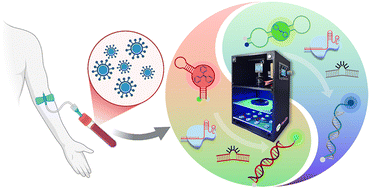
Hepatitis viruses continue to pose a major global health burden, underscoring the critical role of early diagnosis in achieving effective disease control. Here, a ratiometric fluorescence biosensor based on Cas13a and fluorescent RNA aptamers was developed for the highly efficient detection of hepatitis viruses. The integrated system consists of three functionally coupled modules: (i) duplex-specific nuclease (DSN)-enabled target recognition and sequence-specific cleavage, (ii) Cas13a-activated collateral degradation, and (iii) fluorescent RNA aptamer-based ratiometric biosensor. The proof-of-concept evaluation established limits of detection of 7.4 copies per µL for the hepatitis B virus (HBV) gene and 2.9 copies per µL for the hepatitis C virus (HCV) gene, respectively. Subsequently, image discrimination was performed using a portable fluorescence imaging device. By innovatively merging classical image processing with AI algorithms, the system achieved significantly enhanced stability and anti-interference capability in image analysis. As a result, the efficiency of this platform was successfully validated through the analysis of clinical samples, achieving a specificity of 100% and a sensitivity of over 96.3%, thereby demonstrating its high diagnostic accuracy. The proposed strategy demonstrates significant potential as a sensitive and highly specific diagnostic platform for hepatitis virus detection.
- This article is part of the themed collection: 15th Anniversary: Chemical Science Leading Investigators collection
 Please wait while we load your content...


