


A journey through metallophilic interactions: computational approaches and insights

Abstract
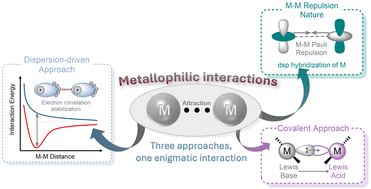
Metallophilic interactions, defined as counterintuitive weak attraction between closed–shell metal cations, are essential for stabilizing molecular and solid-state structures, driving supramolecular assemblies or designing functional materials. Despite over half a century of intensive study, the physical origin of metallophilic interactions remains controversial, with competing perspectives arising from the interplay of dispersion, relativistic effects, covalency, or Pauli repulsion concepts. This perspective provides a comprehensive review of computational studies published since 2020, with a focus on both classical and emerging approaches. State-of-the-art computational methods are critically assessed, emphasizing their limitations, inconsistencies, and the implications these challenges pose for accurately describing these interactions. Finally, we highlight open questions and unresolved challenges, underscoring the urgent need for deeper insight into these enigmatic interactions, which continue to captivate both computational and experimental researchers alike.
- This article is part of the themed collection: 2025 Frontier and Perspective articles
 Please wait while we load your content...


