


CO2 photoreduction with heterogeneous organic photocatalysts based on π-conjugated monomers: structure–property insights and regulation strategies
 *a
*a
Abstract
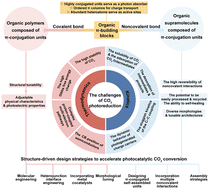
The visible-light-driven photoreduction of CO2 into value-added chemicals is regarded as a promising approach to alleviating the energy crisis and addressing climate change. Heterogeneous organic photocatalysts based on π-conjugated monomers, including organic polymers/organic supramolecules composed of π-conjugation units, have demonstrated significant progress in CO2 photoreduction, attributed to their remarkable light absorption, abundant reserves of constituent elements, and tunable molecular structures. This review provides a comprehensive yet focused exploration of the general structural features of organic polymers/organic supramolecules composed of π-conjugation units, offering structure-driven design strategies tailored to address the key limitations associated with each material class in the field of CO2 photoreduction. For the organic polymers, molecular engineering, interfacial modification, and morphological control collectively overcome key thermodynamic and kinetic bottlenecks in CO2 photoreduction, leading to enhanced catalytic performance. Many of these approaches are equally applicable to organic supramolecules, wherein we further highlight the design of π-conjugated units that simultaneously serve as catalytic centers and defined sites for noncovalent interactions, and assembly strategies that enable control over aggregation states to construct precisely defined supramolecular architectures. Furnished with foundational knowledge and structure–property insights, this review predicts outstanding challenges. It outlines feasible research directions for heterogeneous organic photocatalysts based on π-conjugated monomers, offering an actionable design paradigm for advancing the rational development of next-generation organic photocatalysts for efficient solar-driven CO2 conversion.
- This article is part of the themed collection: 2025 Frontier and Perspective articles
 Please wait while we load your content...


