Linjie Wei, Yi Liu, Yu Ma, Qingshun Fan, Liwei Tang, Jingtian Zhang, Junhua Luo and Zhihua Sun
J. Mater. Chem. C, 2025,13, 1675-1679
DOI:
10.1039/D4TC04488F,
Paper


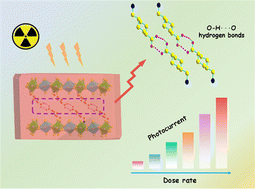
Ruddlesden–Popper (RP) hybrid perovskites hold great potential for X-ray detection, while the inherent van der Waals gap hinders the preparation of large single crystals. Therefore, reducing the interlaminar energy gap in 2D RP-type perovskites is crucial for exploiting high-performance crystal-based X-ray detectors. We here present a new 2D RP-type double perovskite, (t-ACH)4AgBiI8·H2O (1, t-ACH = 4-aminomethyl-1-cyclohexane carboxylate), of which the intercalated carboxylate spacers form strong interlaminar O–H⋯O hydrogen bonds and favor the elimination of the van der Waals energy gap. This enhanced interlaminar connection in its quasi-2D motif facilitates the growth of large single crystals. As expected, bulk high-quality single crystals of 1 with a centimeter size up to 17 × 12 × 8 mm3 were facilely obtained, which exhibit notable semiconductor properties of low trap density (∼6.57 × 1010 cm−3) and large mobility-lifetime (∼0.77 × 10⁻³ cm2 V−1) in the direction vertical to the (−100) plane. Particularly, the single crystal-based detector of 1 shows prominent performance in X-ray detection, including a low dark current drift of 1.97 × 10⁻⁷ nA cm−1 s−1 V−1, a high sensitivity of 3221.6 μC Gyair−1 cm−2, and a low detection limit of 12 nGyair s−1. The figure-of-merit of detection sensitivity is approximately 180 times than the commercial a-Se X-ray detectors. This intercalation of strong O–H⋯O hydrogen bonds reduces the van der Waals gap in 2D RP-type perovskites, which serves as an effective strategy to explore new eco-friendly perovskites for high-performance photoelectric applications.