Issue 24, 2025

Enhancing mechanical-to-charge conversion in triboelectric nanogenerators

Abstract

Triboelectric nanogenerators (TENGs) hold transformative promise for renewable energy harvesting and as power sources for the Internet of Things. However, a key challenge remains in concurrently enhancing their output energy and energy conversion efficiency, especially at high triboelectric charge densities. Here, our study reveals that increased frictional heat and electrostatic force at elevated charge densities lead to greater energy dissipations, thereby limiting efficiency improvements. To address this issue, we introduce a novel metric, the mechanical-to-charge conversion factor (fM–Q), which quantitatively correlates surface charge density with friction force. This enables simultaneous assessment and optimization of output energy and energy conversion efficiency. Assisted by strategic material selection and interfacial lubrication, this synergy elevates fM–Q by 7.8-fold, achieving a remarkable 17-fold enhancement in energy conversion efficiency and a record-breaking energy density of 11.9 J m−2 cycle−1. This work provides new insights into advancing practical triboelectric technologies with benefits of both performance and efficiency.
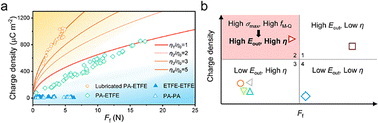
Graphical abstract: Enhancing mechanical-to-charge conversion in triboelectric nanogenerators

Supplementary files

Transparent peer review

To support increased transparency, we offer authors the option to publish the peer review history alongside their article.

View this article’s peer review history

Article information

Article type
Paper
Submitted
14 Jul 2025
Accepted
11 Nov 2025
First published
18 Nov 2025
This article is Open Access
Creative Commons BY-NC license

Energy Environ. Sci., 2025,18, 10403-10412

Enhancing mechanical-to-charge conversion in triboelectric nanogenerators

L. Zhou, D. Liu, Y. Gao, W. Qiao, D. Liu, Z. Zhao, L. Yin, X. Li, Z. L. Wang and J. Wang, Energy Environ. Sci., 2025, 18, 10403 DOI: 10.1039/D5EE03995A

This article is licensed under a Creative Commons Attribution-NonCommercial 3.0 Unported Licence. You can use material from this article in other publications, without requesting further permission from the RSC, provided that the correct acknowledgement is given and it is not used for commercial purposes.

To request permission to reproduce material from this article in a commercial publication, please go to the Copyright Clearance Center request page.

If you are an author contributing to an RSC publication, you do not need to request permission provided correct acknowledgement is given.

If you are the author of this article, you do not need to request permission to reproduce figures and diagrams provided correct acknowledgement is given. If you want to reproduce the whole article in a third-party commercial publication (excluding your thesis/dissertation for which permission is not required) please go to the Copyright Clearance Center request page.

Read more about how to correctly acknowledge RSC content.

Social activity

Spotlight

Advertisements