Yoohyeon Choi, Ngoc Tuan Tran, Doojoon Jang, Minju Park, Chun-Jae Yoo, Jin Young Kim, Hyunjoo Lee and Heesuk Kim
Green Chem., 2024,26, 330-339
DOI:
10.1039/D3GC03944G,
Paper


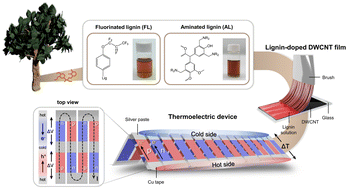
As global interest in carbon-neutrality policies grows, the demand for sustainable alternatives to fossil fuels intensifies. Herein, we demonstrate functionalized lignin-based n- and p-dopants for nanocarbon materials, providing promising eco-friendly alternatives to chemical dopants derived from fossil fuels. A simple microwave-assisted phenolation of organosolv lignin introduces phenol groups, offering additional reaction sites and enhancing solvent solubility for uniform, reliable and efficient carbon nanotube (CNT) doping. To create effective n- and p-dopants, the phenolated lignin is further functionalized with amine and hexafluoropropyl groups, respectively. The aminated and fluorinated lignin-doped CNTs present the Seebeck coefficients of −48.0 and 53.9 μV K−1, respectively, confirming an efficient and eco-friendly conversion between n- and p-type CNT. Notably, this n-doping performance is of particular significance since stable and reliable n-doping is challenging due to the inherent p-type semiconducting properties of CNTs. As a proof of concept, we demonstrate a flexible thermoelectric generator using 10 p–n pairs of the CNT films. The output voltage (7.86 mV) and output power (247 nW) of the flexible generator at ΔT = 15 K confirm that the aminated- and fluorinated lignin-doped CNT films exhibit n- and p-type characteristics, respectively. This study paves the way for sustainable, lignin-based doping of carbon nanomaterials, offering a green alternative to traditional fossil fuel-derived dopants and contributing to the transition towards carbon-neutral technologies.