Seung-Keun Park, Gi Dae Park and Yun Chan Kang
Nanoscale, 2018,10, 11150-11157
DOI:
10.1039/C8NR02686F,
Paper


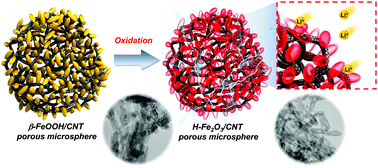
It is highly desirable to develop anode materials with rational architectures for lithium ion batteries to achieve high-performance electrochemical properties. In this study, three-dimensional porous composite microspheres comprising hollow Fe2O3 nanorods/carbon nanotube (CNT) building blocks are successfully constructed by direct deposition and further thermal transformation of beta-FeOOH nanorods on CNT porous microspheres. The CNT porous microsphere, which is prepared by a spray pyrolysis, provides ample sites for the direct growth of beta-FeOOH nanorods. During the further oxidation process, the beta-FeOOH nanorods are transformed into hollow Fe2O3 nanorods as a result of dehydroxylation and lattice shrinkage, resulting in the formation of hollow Fe2O3 nanorods/CNT porous microspheres. Such a hierarchical structure of composite microspheres not only facilitates electrolyte accessibility but also offers conductive networks for electrons during electrochemical reactions. Accordingly, the electrodes exhibit a high discharge capacity of 1307 mA h g−1 after 300 cycles at a current density of 1 A g−1; this is associated with an excellent capacity retention of 84%, which is calculated from the initial cycle. In addition, the composite delivers a discharge capacity of 703 mA h g−1 at a current density of 15 A g−1.