Jason A. Perman, Meng Chen, Antony A. Mikhail, Zheng Niu and Shengqian Ma
CrystEngComm, 2017,19, 4171-4174
DOI:
10.1039/C7CE00405B,
Communication


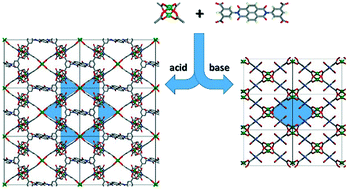
The ubiquitous [Cu(O2CR)4] paddlewheel molecular building block (MBB) is renowned for producing highly porous metal–organic frameworks (MOFs), yet some carboxylate based ligands can result in supramolecular isomers. We show that it is possible to manipulate the synthesis conditions to favor one isomer over another yielding MOFs with either an lvt or nbo topology. These isomers exist because the 4-connected paddlewheel MBB and isophthalate based ligand can form either a square grid or a Kagomé lattice, where layers can join to give their respective framework topologies. Topology differences and accessible Cu(II) centers in isomers of [Cu2L]n were evaluated for their porous properties towards CO2 and their abilities to transform CO2 into value added chemicals under ambient conditions.