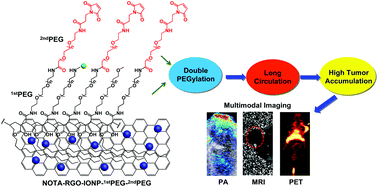
Polyethylene glycol (PEG) surface modification is one of the most widely used approaches to improve the solubility of inorganic nanoparticles, prevent their aggregation and prolong their in vivo blood circulation half-life. Herein, we developed double-PEGylated biocompatible reduced graphene oxide nanosheets anchored with iron oxide nanoparticles (RGO–IONP–1stPEG–2ndPEG). The nanoconjugates exhibited a prolonged blood circulation half-life (∼27.7 h) and remarkable tumor accumulation (>11 %ID g−1) via an enhanced permeability and retention (EPR) effect. Due to the strong near-infrared absorbance and superparamagnetism of RGO–IONP–1stPEG–2ndPEG, multimodality imaging combining positron emission tomography (PET) imaging with magnetic resonance imaging (MRI) and photoacoustic (PA) imaging was successfully achieved. The promising results suggest the great potential of these nanoconjugates for multi-dimensional and more accurate tumor diagnosis and therapy in the future.