Muneeb Ahmad, Hyojung Kim, Harshada Patil, Yoon Ho Lee and Deok-kee Kim
J. Mater. Chem. C, 2025,13, 18540-18554
DOI:
10.1039/D5TC00530B,
Highlight


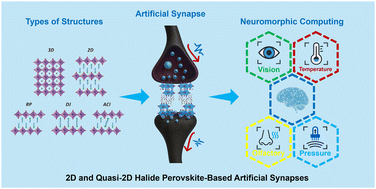
The field of neuromorphic computing has seen significant advancements through the development of artificial synapses, with two-dimensional (2D) and quasi-2D halide perovskites emerging as key materials in this area. These materials exhibit remarkable properties such as resistive switching, fast charge carrier mobility, and low power consumption, making them ideal candidates for emulating synaptic behavior in artificial neural networks. This article reviews the fundamental principles behind artificial synapses and explores the progress made in utilizing 2D and quasi-2D halide perovskites for synaptic emulation. Key phenomena like short-term and long-term potentiation, spike-timing dependent plasticity, and associative learning are replicated in these materials, offering insights into their potential applications in energy-efficient computing systems. Furthermore, the challenges associated with air stability and the ongoing efforts to improve the performance and reliability of perovskite-based synaptic devices are thoroughly examined. The review also highlights the promising future of these materials in applications ranging from visual systems to sensory adaptation and beyond. This article provides a comprehensive overview of the current state of research in perovskite-based artificial synapses and their role in advancing neuromorphic computing.