


Are supramolecular synthons stable as discrete units? Results from a series of salts of 4-(4-hydroxyphenylazo)benzoic acid and its derivatives with aminopyridines

Abstract
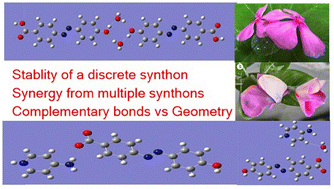
Analysis of a supramolecular synthon is an integral part of understanding, describing, and designing non-covalent assemblies. The energies of synthons play a key role in their formation and disruption, resulting in the conversion into a new assembly. The analysis also provides an opportunity to understand their collective effects by being a part of an assembly. We have performed a structural study and analyzed the synthons in 4-(4-hydroxyphenylazo)benzoic acid (H2AZOBEN) and its salts with 2-aminopyridine, 4-aminopyridine, and pyrimidin-2-amine derivatives to show the collective contributions of the synthons to stability. The energies of identified synthons from the observed crystal structures were independently optimized by DFT calculations using the M062X functional together with QZVP and 6-311+G(d,p) basis sets. MM2-surface charge-density calculations on the salt of formic acid with aminopyridine or aminopyrimidine demonstrated that the geometrical arrangements in discrete combinations are not through the complementary hydrogen-bonded R22(8) heterodimers, but the anion and cation have perpendicular orientations. The crystal structure of the hydrate of H2AZOBEN showed the presence of a hydrogen-bonded water bridge, and theoretical calculations suggested that this was the key feature in the stabilization of the assembly. Similarly, the gain in energy by hydration in hydrates was compared with the energy of different synthons in anhydrous forms to show that hydration is key to their stability. The combined effects of different synthons were found to be a key factor providing relative stability compared to a single one. In the assemblies of methoxy or ethoxy derived H2AZOBEN, the ethereal oxygen did not participate in the scheme of hydrogen bonds. This is attributed to the C–H⋯π interactions of the C–H bonds of the methyl and ethyl groups, which provide directional properties to the assembly and also an environment to the O-atom without a good hydrogen bond acceptor in its proximity.
- This article is part of the themed collection: Structure and dynamics of chemical systems: Honouring N. Sathyamurthy’s 75th birthday
 Please wait while we load your content...


