


Extraction, quantification and characterization of mercury and selenium containing nanoparticles in seal livers using single particle inductively coupled plasma time of flight mass spectrometry (spICP-ToF-MS)
 a
Chrystelle
Lessard,
a
Sofia
Paciello,
b
Dominic E.
Ponton,
b
Marc
Amyot
b
and
Kevin J.
Wilkinson
*a
a
Chrystelle
Lessard,
a
Sofia
Paciello,
b
Dominic E.
Ponton,
b
Marc
Amyot
b
and
Kevin J.
Wilkinson
*a
Abstract
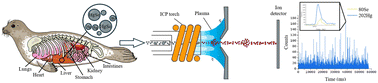
Mercury accumulation in Arctic marine mammals presents significant environmental and health concerns, particularly for Indigenous communities relying on these animals as traditional food sources. This study developed a protocol for quantifying and characterizing mercury selenide (HgSe) nanoparticles in seal livers using single particle inductively coupled plasma time-of-flight mass spectrometry (spICP-ToF-MS). The initial key challenge was the extraction of the nanoparticles from the biological tissue, using the least perturbing means and simplest extraction matrix in order to preserve the HgSe nanoparticles. Five extraction methods (formic acid, proteinase & lipase, lipase, tetramethylammonium hydroxide, and ultrapure water) were compared by extracting HgSe nanoparticles from the liver of a bearded seal (Erignathus barbatus). Metals and metalloids in individual nanoparticles were measured by spICP-ToF-MS. Based on the particle number and the particle size distributions, formic acid was the best medium for the extraction of the HgSe nanoparticles. The HgSe nanoparticles remained structurally stable in formic acid extracts for extended periods (up to one month), with minimal changes in the particle numbers or particle size distributions. spICP-ToF-MS allowed determination of the stoichiometry of the individual HgSe nanoparticles and also revealed previously unreported trace amounts of silver (1%) and bismuth (0.5%) associated with the nanoparticles. These results expand our understanding of selenium's protective role beyond mercury sequestration, suggesting a conserved detoxification mechanism involving multi-element selenide complexes. This study establishes a robust analytical methodology for investigating metal detoxification at the nanoscale, providing insights into mercury cycling in Arctic ecosystems and exposure risks for communities consuming marine mammals.
- This article is part of the themed collection: Recent Open Access Articles - Environmental Science: Processes & Impacts
 Please wait while we load your content...


