


Substituent-controlled photocyclization pathways of 3H-azepines: insights from TD-DFT and bonding evolution theory

Abstract
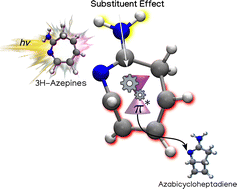
The photocyclization of 3H-azepines exhibits a striking substituent-dependent preference toward the formation of the 2-azabicyclo[3.2.0]hepta-2,6-diene isomer, in agreement with experimental findings, while 6-substituted analogues remain unobserved. Through time-dependent density functional theory (TD-DFT) and bonding evolution theory (BET) analyses, we reveal how subtle electronic effects govern the excited-state reaction landscape. The nature of the substituent at position 2 dictates the topology of the excited S1 state. For electron-donating groups (–NH2 and –OEt), the excitation is mainly localized over the olefinic bonds of the ring, whereas electron-withdrawing groups (–CN and –CF3) localize it on the imine bond. Donor-substituted systems access two minimum-energy conical intersections (MECI-1 and MECI-2) on the excited-state surface: deactivation through MECI-1 regenerates the 3H-azepine reactant, while the MECI-2 pathway leads to a strained intermediate that efficiently evolves into the experimentally observed bicyclic product, overcoming low energy barriers (<8 kcal mol−1). In contrast, electron-withdrawing substituents only provide access to the MECI-1 pathway, preventing the formation of the bicyclic product. This study provides a unified mechanistic rationale for the regioselectivity of 3H-azepine photocyclization, and illustrates how substituent electronics sculpt the excited-state reactivity landscape of heterocyclic systems.
 Please wait while we load your content...


