


Co-assembly of structurally different biomacromolecule-modified maghemite nanoparticles with nitrate sequestration potential

Abstract
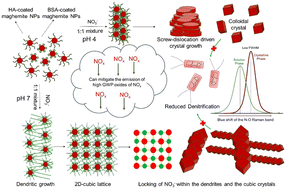
The co-assembly of humic acid (HA)-coated maghemite nanoparticles (H-GFeNPs) and bovine serum albumin (BSA)-modified maghemite nanoparticles (B-GFeNPs) and sequestration of NO3− within the colloidal crystals were investigated. The π–π interaction between aromatic moieties of the adsorbed BSA and HA controlled the co-assembly process. The 1 : 1 binary mixture of H-GFeNPs and B-GFeNPs at pH 4 showed screw dislocation-driven growth of colloidal crystals, especially at higher concentrations of NO3−. But, at pH 7, the binary mixture in the presence of NO3− produced spherical dendritic nanostructures and hierarchical growth of dendrites. However, at higher levels of NO3−, the binary mixture produced a 2D cubic lattice and rock salt-like 3D colloidal crystals. In addition, we also detected the growth of dendrites, ubiquitous in rock salt-type crystal growth, specifically in an unsaturated environment. The binding of NO3− to the hydrophobic and positively charged residues of the protein, supplemented by the loss of α-helix and the reduced radius of gyration (Rg), possibly favored crystal growth. Signatures of the NO3− specific Raman bands within the colloidal crystals discerned the sequestration of the highly mobile contaminant ion within the crystalline domain, therefore potentially diminishing the atmospheric emission of high global warming potential (GWP) oxides of N produced via denitrification.
- This article is part of the themed collection: HOT articles from Environmental Science: Nano
 Please wait while we load your content...


