


Chemical control for the morphogenesis of conducting polymer dendrites in water
 †a
Corentin
Scholaert,
†a
David
Guérin,
a
Yannick
Coffinier,
a
Fabien
Alibart
b
and
Sébastien
Pecqueur
*a
†a
Corentin
Scholaert,
†a
David
Guérin,
a
Yannick
Coffinier,
a
Fabien
Alibart
b
and
Sébastien
Pecqueur
*a
Abstract
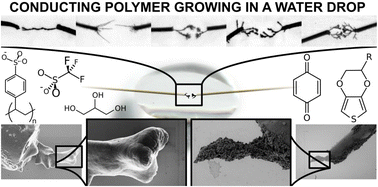
Conducting polymer dendrite (CPD) morphogenesis is an electrochemical process that enables in materio evolving intelligence in wetware devices. During CPD morphogenesis, voltage transients drive the physical evolution of electrically conductive structures, thereby programming their filtering properties as nonlinear analog devices. Whether studied in an electrochemical experiment or in neuromorphic devices, the dependence of the electrical properties of the electrogenerated structures on the chemical composition of their growth environment is still unreported. In this study, we report the existing interconnection between the nature and concentration of the electrolytes, electroactive compounds and co-solvents and the electrical and electrochemical properties of CPDs in an aqueous electrolyte. CPDs exhibit various chemical sensitivities in water: their morphology is highly dependent on the nature of the chemical resources available in their environment. The selection of these resources therefore critically influences morphogenesis. In addition, the concentrations of the different electrochemical species have varying impacts on growth dynamics, modulating the balance between thermodynamic and kinetic control over polymer electrosynthesis. By correlating the dependencies of these evolving objects with the availability of the chemical resources in an aqueous environment, this study offers guidelines to tune the degree of evolution of electronic materials in water and highlights potential avenues for their application. Such evolving hardware is envisioned to exploit the chemical complexity of real-world environments as part of information processing technologies.
- This article is part of the themed collection: RSC Applied Polymers HOT Article Collection
 Please wait while we load your content...


