


Facile synthesis of metal-free N-doped carbon electrocatalyst from acetone aldol reaction products towards selective CO2-to-CO conversion
 *ab
Yoshiaki
Uchida
a
and
*ab
Yoshiaki
Uchida
a
and
Abstract
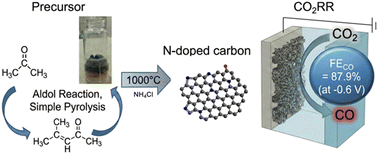
Electrochemical CO2 reduction (CO2RR) is a promising method for producing useful chemicals from CO2 using electricity, including that derived from renewable energy sources. Among the possible products, CO is an important intermediate in the synthesis of fuels and chemicals. Metal-free carbon catalysts have been proposed as durable and low-cost alternatives to metal-based catalysts. However, many synthesis routes involve complex steps or the use of transition metals. In this study, we propose a simple method for preparing a metal-free catalyst using acetone aldol reaction products and ammonium chloride. This catalyst achieved a CO Faradaic efficiency of 87.9% at −0.6 V vs. RHE. A structure–activity analysis revealed that the CO current density showed a positive correlation with specific surface area and an inverse correlation with total nitrogen content. This finding indicates that nitrogen desorption contributes to the formation of abundant pores. This enhanced porous structure is expected to improve mass transport and active site exposure, thereby enhancing catalytic performance.
- This article is part of the themed collections: Catalysis Science & Technology Open Access Spotlight 2026 and Advanced Catalytic Materials for Energy and Environmental Applications
 Please wait while we load your content...


