Three-component tandem benzyl-C(sp3)–H functionalization via thermally generated arynes with phenazine

Yajuan Zhang , Fuxiang Chai , Qiong Hu , Meng Chang , Ruihua Qiang and Yimin Hu *
Laboratory of Functional Molecular Solids, Ministry of Education, Anhui Key Laboratory of Molecular-Based Materials, School of Chemistry and Materials Science, Anhui Normal University, Wuhu, Anhui 241000, China. E-mail: yiminhu@ahnu.edu.cn

Received 17th November 2025 , Accepted 16th December 2025

First published on 9th January 2026


Abstract

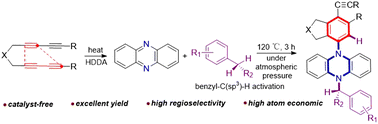
A rare strategy for three-component tandem benzyl-C(sp3)–H functionalization via thermally generated arynes with phenazine without a catalyst was developed for the first time. A series of novel fused N,N′-disubstituted dihydrophenazine derivatives were synthesized with excellent yield and high atomic utilization. Deuterium-labelling studies suggested that the formation of carboanion intermediates has a significant role in the reaction. Our data enrich the field of C(sp3)–H functionalization and promote the development of aryne chemistry.

Introduction

Carbon–hydrogen bond functionalization is a breakthrough technology in organic chemistry.1,2 It was weaned from the dependence on the pre-modification of functional groups in traditional organic synthesis. Functionalization of carbon–hydrogen bonds provides an efficient and facile strategy for the construction of complex molecular skeletons.3 It is of great importance in organic synthesis,4 drug development5 and material sciences.6 Several types of C–H bond functionalization,7 mainly transition metal (Rh,8 Pd,9 Au,10 Ru,11 Ir,12 Fe,13 Ag14 and Cu15) catalysis, electrocatalysis,16 photocatalysis,17 and acid/base-catalysis18 have been described. Transition metal-catalyzed C–H functionalization is one of the most mainstream methods.19 The C–H bond functionalization reaction carried out by transition metals and their complexes as catalysts operates by reducing the energy barrier of the C–H bond20 by coordination of the directing group on substrates or promoting C–H bond cleavage through changes in the redox state of metals.21 Classification of C–H bond functionalization can be divided into C(sp)–H, C(sp2)–H and C(sp3)–H bond functionalization according to hybridization of the carbon atom.22 Typically, the C(sp)–H (alkyne C–H) bond can be activated readily by transition metals or strong bases thanks to the higher bond energy and weak acidity of the alkyne hydrogen. Although successful C–H sp–sp3 cross-coupling is difficult to achieve, it has been reported in recent years.23 Functionalization of C(sp2)–H bonds (alkenyl/aromatic C–H bonds) is challenging, yet prevalent.24 The C–H bonds on both sides of the plane of the alkene can be attacked by various reagents readily,25 while the aromatic stabilization energy needs to be overcome during activation of the aromatic C–H bond for the surrounding aromatic π-electron clouds.26

Su and co-workers developed Cu–Pd bimetallic catalysts for multiple remote C(sp3)–H functionalizations of aliphatic ketones.27 They overcame the challenge of continuous dehydrogenation and desaturation of terminal unsubstituted alkyl chains in aliphatic ketones (Scheme 1a). Furthermore, metal-free C(sp3)–H functionalization has also received considerable interest recently. A successful, metal-free three-component alkyl-C(sp3)–H functionalization reaction of arylacetylenes with phthalazines in dichloromethane or acetonitrile (Scheme 1b) has been reported by Chenoweth's group.28 Likewise, intramolecular hydride transfer to arynes-enabled redox-neutral and transition metal-free C(sp3)–H functionalization of amines (Scheme 1c) was disclosed by Jones’ group,29 which generated a new C(sp3)–C(sp3/sp2/sp) bond to nitrogen in a single synthetic operation. Reports have been published on the C(sp3)–H bond functionalization reaction mediated by arynes synthesized via conventional approaches.30 However, the realization of benzyl-C(sp3)–H functionalization via benzynes generated through the hexadehydro-Diels–Alder reaction is pending.


image file: d5ob01818h-s1.tif
Scheme 1 Examples of C(sp3)–H bond functionalization and our work.

Extremely low stability and highly unsaturated cyclic intermediates-benzyne intermediates31 possess high reactivity which can be captured by various reagents readily and generated by the hexadehydro-Diels–Alder reaction32 (thermal cycloisomerization) of a 1,3-diyne or remotely chained diynophile. Herein, we report an unprecedented strategy (Scheme 1d) based on our previous work:33 three-component tandem benzyl-C(sp3)–H functionalization via thermally generated arynes with phenazine. Tetrayne substrates were reacted with phenazine under a series of benzylic solvents only by heating, and generated a novel fused N,N′-disubstituted dihydrophenazine derivative34 in the absence of a catalyst. We have provided a convenient method for the synthesis of dihydrophenazine derivatives, and simultaneously enriched the field of C–H bond functionalization and promoted the development of aryne chemistry.

Results and discussion

Initially, we blended a tetrayne substrate (1a) and phenazine (2a) with 3 mL of toluene under heating and observed the reaction. A new yellow-green and fluorescent spot was observed after the thin-layer chromatography analysis of a brown-green reaction mixture had been carried out. We cultured a single crystal of 4a and the structure of the final product was confirmed by X-ray diffraction.37 Through analyses of the single crystal structure of the target product, we found that formation of this compound involved a three-component tandem reaction. Most strikingly, toluene was also involved in the reaction as one of the reactants. Meanwhile, a very rare case of benzyl-C(sp3)–H functionalization occurred in the absence of a cocatalyst. This is different from the previously reported benzylic C–H (activation/functionalization) mediated by metal catalysis.35

Having established the feasibility of this type of reaction, we used a tetrayne with the same aromatic group but containing different esters (OMe, OEt, or OiPr) to react (Table 1). If the ester substituent on tetraynes was changed, the yield of the target product (4a, 4b and 4c) fluctuated slightly (range from 77% to 84%), which indicated that the tetraynes of different esters had little effect on the yield of the product. Next, we investigated the applicability of the reaction (Table 2). Tetrayne substrates with different aromatic substituents under optimized conditions were employed (see SI). The tetrayne with different electron-donating (p-Me, p-Et, p-nPr and m-Me) or electron-withdrawing (p-Cl, p-F and m-Cl) groups of the aromatic substituents reacted with phenolazine and toluene to undergo a three-component tandem reaction to afford a series of N,N′-disubstituted dihydrophenazine derivatives (4d–4r). Target compounds (e.g., 4f, 4g, 4h, 4k, 4q and 4r) with different electron-donating aryl-substitutes were isolated in good yields (71% to 80%). Compounds (e.g., 4d, 4e, 4i, 4l, 4m and 4p) with various electron-withdrawing aryl-substitutes were isolated in good yields (75% to 88%). In addition, the structures of 4d and 4j were confirmed37 by X-ray diffraction.

Table 1 Three-component tandem reaction via different tetraynesa,b
a Conditions: tetraynes 1a–1c (1.0 equiv.), phenazine 2a (1.0 equiv.), 3a toluene (3.0 mL), and stirred at 120 °C for 3 h. b Yield of isolated product after flash column chromatography.
image file: d5ob01818h-u1.tif


Table 2 Three-component tandem reaction via different tetraynesa,b
a Conditions: tetraynes 1d–1r (1.0 equiv.), phenazine 2a (1.0 equiv.), 3a toluene (3.0 mL), and stirred at 120 °C for 3 h. b Yield of isolated product after flash column chromatography.
image file: d5ob01818h-u2.tif


We also explored the applicability of this type of reaction to various benzylic solvents (Table 3). First, we screened several types of commonly used organic solvents but lacking a CH3-group (chlorobenzene, 1,2-dichloroethane, 1,2-dichlorobenzene) blended with tetrayne, phenolazine or toluene under heating (120–130 °C). Disappointingly, we did not obtain the target products. A reason for this phenomenon might have been that the introduction of different solvents broke the dual equilibrium of the original reaction solvent as the reactant and reaction medium, so the reaction could not occur. Subsequently, we replaced toluene with CH3CN and mixed it with tetrayne or phenazine under heating (120–130 °C), but again the target product could not be obtained. We speculated that it was hard for the benzyne intermediate after tetrayne cycloisomerization to obtain protons from these solvents, which hampered the formation of carbon anions and the target product could not be obtained. Therefore, we chose mesitylene (3b), m-xylene (3c) or 4-chlorotoluene (3d) to react with tetrayne and phenazine. To our delight, as shown in Table 3, the reaction was effective in mesitylene, m-xylene and 4-chlorotoluene to afford the desired benzyl-C(sp3)–H functionalization products, respectively (4s–4x, 4y–4A and 4B–4D) in good yields (70% to 85%), and the structures of 4x, 4A and 4B were confirmed by X-ray diffraction (Table 4).37

Table 3 Scope of application of the reaction substratea,b
a Conditions: tetraynes 1s–1D (1.0 equiv.), phenazine 2a (1.0 equiv.), 3b, 3c and 3d (3.0 mL), and stirred at 120 °C for 3 h. b Yield of isolated product after flash column chromatography.
image file: d5ob01818h-u3.tif


Table 4 Scope of application of the reaction substratea,b
a Conditions: tetraynes 1E–1G (1.0 equiv.), phenazine 2a (1.0 equiv.), 3e (3.0 mL), stirred at 120 °C for 2 h. b Yield of isolated product after flash column chromatography.
image file: d5ob01818h-u4.tif


We also investigated the compatibility of ethylbenzene and cumene for the reaction. Ethylbenzene could also react with tetrayne and phenozine if stirred at 120 °C for 2 h and we obtained the target products 4E, 4F and 4G efficiently (yields ranging from 71% to 75%). We confirmed the structures of 4F through X-ray diffraction.37 It is notable that the reaction site was a methylene carbon (benzyl carbon) that connected directly to the benzene ring. Conversely, we did not observe the three-component products of the cumene if we lengthened the reaction time or increased the reaction temperature. This effect may have been caused by two reasons. First, the methyl group is an electron-donating group. The more methyl groups obtained, the greater is the likelihood of negative charge being more concentrated, which contributes to greater destabilization of the carbon anion. The second reason is the influence of steric hindrance elicited by the isopropyl group.

Interestingly, 4H (72%) and 4I′ (11%) were invested in various reaction types of products that were different from the above reactions if phenazine was replaced with 1-methoxyphenazine (Scheme 2). Besides, the structures of 4H and 4I′ were confirmed by X-ray diffraction.37 The reason underlying this phenomenon may have been a p–π conjugate effect arising through the large π bond of the phenazine ring with the methoxy group. This would have contributed to the nucleophilicity of the phenazine ring being enhanced, so a cycloaddition reaction would be more likely to occur.


image file: d5ob01818h-s2.tif
Scheme 2 Reaction of 1-methoxyphenazine with tetrayne.

After considering the above experimental examples, depicted in Scheme 3a is the possible mechanism of the three-component tandem benzyl-C(sp3)–H functionalization via thermally generated arynes with phenazine.28,29 Taking the synthesis of compound 4a as an example, tetrayne 1a undergoes cycloisomerization under thermal conditions to form the benzyne intermediate INT1. Then, the lone-pair electrons of the N atom in phenazine (2a) attack the benzyne to generate the intermediate INT2 (INT2′). The aryl anion part of the intermediate INT2 (INT2′) has higher basicity. The highly basic phenyl anion abstracts the benzylic proton of the solvent under certain conditions36 and undergoes the transition state TS1 while generating the intermediates INT3 and INT4. When intermediate INT3 is formed, the positive charge delocalizes to the para-position N atom through the conjugated system, which reduces the electron cloud density of N atoms significantly and presents a partial positive charge. Simultaneously, an electrostatic attraction is formed with the negative charge of INT4 while reducing the functionalization energy of the reaction (charge matching drives a nucleophilic attack). This leads to the N atom in the para-position becoming more likely to react with the carbon anion (INT4) and compound 4a is generated eventually.


image file: d5ob01818h-s3.tif
Scheme 3 Proposed mechanism.

To gain insight into the mechanism of three-component tandem benzyl-C(sp3)–H functionalization via thermally generated arynes with phenazine, a deuterium-labelling experiment was conducted (Scheme 3b). The deuterium-labelled product 4J was isolated in 76% yield under optimized reaction conditions (see SI), and we confirmed the structure of 4J through NMR spectroscopy. Fig. 1 shows the 1H NMR spectra of compound 4c and compound 4J. Compound 4J was the deuterated product of compound 4c.


image file: d5ob01818h-f1.tif
Fig. 1 Comparison of 1H NMR spectra.

Compared with compound 4c, the 1H NMR spectrum signal peaks of a (–CH2, 2H), b (–Ar, 4H), c (–Ar, 1H) and d (–Ar, 1H) in the deuterated product 4J disappeared, which verified the rationality of the proposed mechanism. These results indicated that the formation of carbanion intermediates was crucial to achieve benzyl-C(sp3)–H functionalization.

Conclusions

We created an efficient three-component tandem benzyl-C(sp3)–H functionalization through thermally generated arynes with phenazine. In this strategy, activation of the benzylic-C(sp3)–H bond was only by heating and a catalyst was not needed. A series of novel fused N,N′-disubstituted dihydrophenazine derivatives were synthesized with excellent yield and high atomic utilization. The reaction possessed good tolerance of functional groups: a series of target compounds could be obtained in good yield and high atomic utilization for tetrayne substrates with different substituents and benzylic solvents. Deuterium-labelling studies supported the rationality of the proposed possible reaction mechanism, while affirmed that the formation of carboanion intermediates had a significant role in the reaction. We have provided a feasible method for the synthesis of dihydrophenazine derivatives and ultimately enriched the field of C(sp3)–H functionalization while promoting the development of aryne chemistry. Further work on the application of dihydrophenazine derivatives is ongoing in our group.

Author contributions

All authors have given approval to the final version of the manuscript.

Conflicts of interest

There are no conflicts of interest to declare.

Data availability

The data supporting this article have been included as part of the supplementary information (SI). Crystallographic data for compounds 4a, 4d, 4j, 4x, 4A, 4B, 4F, 4H and 4I′ (CCDC 2493648, 2493649, 2493650, 2493651, 2493652, 2493653, 2493654, 2493655 and 2493656) have been deposited in the Cambridge Crystallographic Data Center. Supplementary information is available. See DOI: https://doi.org/10.1039/d5ob01818h.

CCDC 2493648 (4a), 2493649 (4d), 2493650 (4j), 2493651 (4x), 2493652 (4A), 2493653 (4B), 2493654 (4F), 2493655 (4H) and 2493656 (4I′) contain the supplementary crystallographic data for this paper.37a–i

Acknowledgements

The authors thank the National Natural Science Foundation of China (22071001) and Department of Human Resources of Anhui Province for financial support.

References

  1. Y. Qin, L. Zhu and S. Luo, Chem. Rev., 2017, 117, 9433–9520 CrossRef CAS.
  2. K. Godula and D. Sames, Science, 2006, 312, 67–72 CrossRef CAS PubMed.
  3. S. K. Sinha, S. Guin, S. Maiti, J. P. Biswas, S. Porey and D. Maiti, Chem. Rev., 2022, 122, 5682–5841 CrossRef CAS PubMed.
  4. Selected reviews: (a) D.-X. Tan and F.-S. Han, Org. Chem. Front., 2022, 9, 1195–1210 RSC; (b) J. Hu, S. Pradhan, S. Waiba and S. Das, Chem. Sci., 2025, 16, 1041–1070 RSC; (c) K.-H. Liu, G.-Q. Hu, C.-X. Wang, F.-F. Sheng, J.-W. Bai, J.-G. Gu and H.-H. Zhang, Org. Lett., 2021, 23, 5626–5630 CrossRef CAS.
  5. (a) Z. Zhao, J. Huang, Y. Cai, T.-P. Zhou, F. Khatib, D. Shimon, B. Wang and N. Metanis, J. Am. Chem. Soc., 2025, 147, 31811–31820 CrossRef CAS; (b) P. Bellotti, H.-M. Huang, T. Faber and F. Glorius, Chem. Rev., 2023, 123, 4237–4352 CrossRef CAS PubMed.
  6. (a) C.-X. Liu, Q. Gu and S.-L. You, Trends Chem., 2020, 2, 737–749 CrossRef CAS; (b) A. Dey, S. Agasti and D. Maiti, Org. Biomol. Chem., 2016, 14, 5440–5453 Search PubMed.
  7. J. F. Hartwig and M. A. Larsen, ACS Cent. Sci., 2016, 2, 281–292 CrossRef CAS.
  8. Y.-B. Zhang, B.-S. Li, G.-J. Xu, W. Sun and M. Sun, Org. Lett., 2023, 25, 3922–3926 CrossRef CAS.
  9. T. Ishida, M. Tokunaga, Z. Zhang, H. Murayama and E. Yamamoto, Synthesis, 2021, 3279–3289 CrossRef CAS.
  10. Q. Chen, H. Yan, K. Zhao, S. Wang, D. Zhang, Y. Li, R. Fan, J. Li, X. Chen, X. Zhou, Y. Liu, X. Feng, D. Chen and C. Yang, Nat. Commun., 2024, 15, 10732 CrossRef CAS.
  11. C. Shan, L. Zhu, L.-B. Qu, R. Bai and Y. Lan, Chem. Soc. Rev., 2018, 47, 7552–7576 RSC.
  12. S. Bai, X. Chen, X. Hu, Y. Deng, H. Jiang and W. Zeng, Org. Biomol. Chem., 2017, 15, 3638–3647 Search PubMed.
  13. Y.-M. Wei, X.-D. Ma, M.-F. Wang and X.-F. Duan, Org. Lett., 2023, 25, 2745–2749 CrossRef CAS PubMed.
  14. (a) Q.-Z. Zheng and N. Jiao, Chem. Soc. Rev., 2016, 45, 4590–4627 RSC; (b) J. Wang, X. Liu, Z. Wu, F. Li, M.-L. Zhang, Y. Mi, J. Wei, Y. Zhou and L. Liu, Chem. Commun., 2021, 57, 1506–1509 Search PubMed.
  15. (a) Z. Xie, X. Zhu, Y. Guan, D. Zhu, H. Hu, C. Lin, Y. Pan, J. Jiang and L. Wang, Org. Biomol. Chem., 2013, 11, 1390–1398 RSC; (b) M. Sun, C. Chen and W. Bao, RSC Adv., 2014, 4, 47373–47376 RSC.
  16. (a) P. K. Baroliya, M. Dhaker, S. Panja, S. A. Al-Thabaiti, S. M. Albukhari, Q. A. Alsulami, A. Dutta and D. Maiti, ChemSusChem, 2023, 22, e202202201 CrossRef PubMed; (b) T. Münchow, N. K. Pandit, S. Dana, P. Boos, S. E. Peters, J. Boucat, Y.-R. Liu, A. Scheremetjew and L. Ackermann, Nat. Catal., 2025, 8, 257–269 CrossRef; (c) J. Cai, L. Li, C. Wang, S. Qin, Y. Li, S.-Y. Liao, S. Wang, H. Gao, Z. Zhou, Y. Huang, W. Yi and Z. Zeng, Green Chem., 2024, 26, 11524–11530 RSC.
  17. (a) J. He, X. Gong, Y. Li, Q. Zhao and C. Zhu, Molecules, 2024, 29, 4077 CrossRef CAS PubMed; (b) Z. Gao, Y. Jian, S. Yang, Q. Xie, C. Joseph, R. Mcfadzean, B. Wei, J. Tang, J. Yuan, C. Pan and G. Yu, Angew. Chem., Int. Ed., 2023, 62, e202304173 CrossRef CAS.
  18. Selected reviews: (a) H. Komai, T. Yoshino, S. Matsunaga and M. Kanai, Org. Lett., 2013, 13, 1706–1709 CrossRef PubMed; (b) A. K. Sahoo, B. Das, S. J. Panda, C. S. Purohit and A. Doddi, Adv. Synth. Catal., 2024, 366, 2468–2476 CrossRef.
  19. P. Lucy, D. S. Chung, J. Bouffard and S. Lee, Chem. Soc. Rev., 2017, 46, 4299–4328 RSC.
  20. J. Yao, L. Shao, X. Huo and X. Wang, Sci. China: Chem., 2024, 67, 882–889 CrossRef CAS.
  21. V. W. Bhoyare, E. D. S. Carrizo, C. C. Chintawar, V. Gandon and N. T. Patil, J. Am. Chem. Soc., 2023, 145, 8810–8816 CrossRef CAS.
  22. Y. Qin, L. Zhu and S. Luo, Chem. Rev., 2017, 117, 9433–9520 CrossRef CAS.
  23. (a) J. Huang, L. Fu, Z. Tang, X. Ma, X. Zhao and D. Zhao, Chin. Chem. Lett., 2025, 36, 110505 CrossRef CAS; (b) Z.-L. Wang, L. Zhao and M.-X. Wang, Org. Lett., 2012, 14, 1472–1475 CrossRef CAS PubMed.
  24. S. K. Agrawal, S. Porey, Y. Bairagi, S. Maiti, A. C. Bissember and D. Maiti, Chem. Soc. Rev., 2025, 54, 6122–6174 RSC.
  25. Y. Wei, Z. Wang, K. Wang, J. Qiu, Z. Wang, H. Li, X. Duan, K. Guo, X. Bao and X. Wu, Angew. Chem., Int. Ed., 2024, 63, e202317132 CrossRef CAS PubMed.
  26. Q. Lu, S. Mondal, S. Cembellín and F. Glorius, Angew. Chem., Int. Ed., 2018, 57, 10732–10736 CrossRef CAS.
  27. H. Li, C. Yin, S. Liu, H. Tu, P. Lin, J. Chen and W. Su, Chem. Sci., 2022, 13, 13843–13850 RSC.
  28. S. Suh and D. M. Chenoweth, Org. Lett., 2016, 18, 4080–4083 CrossRef CAS.
  29. F. I. M. Idiris, C. E. Majesté, G. B. Craven and C. R. Jones, Chem. Sci., 2018, 9, 2873–2878 RSC.
  30. Selected reviews: (a) Y. Himeshima, T. Sonoda and H. Kobayashi, Chem. Lett., 1983, 1211–1214 CrossRef CAS; (b) R. A. Roberts, B. E. Metze, A. Nilova and D. R. Stuart, J. Am. Chem. Soc., 2023, 145, 3306–3311 CrossRef CAS.
  31. Selected reviews: (a) J. Shi, Y. Li and Y. Li, Chem. Soc. Rev., 2017, 46, 1707–1719 Search PubMed; (b) N. F. F. Nathel, L. A. Morrill, H. Mayr and N. K. Garg, J. Am. Chem. Soc., 2016, 138, 10402–10405 CrossRef PubMed; (c) K. Kamikawa, Nat. Rev. Chem., 2023, 7, 496–510 CrossRef; (d) H. Tan, S. Yu, X. Yuan, L. Chen, C. Shan, J. Shi and Y. Li, Nat. Commun., 2024, 15, 3665 CrossRef CAS PubMed.
  32. Selected reviews: (a) L. L. Fluegel and T. R. Hoye, Chem. Rev., 2021, 121, 2413–2444 CrossRef CAS PubMed; (b) O. J. Diamond and T. B. Marder, Org. Chem. Front., 2017, 4, 891–910 RSC; (c) D. S. Sneddon, P. V. Kevorkian and T. R. Hoye, Chem. Sci., 2025, 16, 2898–2906 RSC; (d) C. Zhu and T. R. Hoye, J. Am. Chem. Soc., 2022, 144, 7750–7757 Search PubMed.
  33. Selected reviews for our previous work: (a) Y. Zhang, Y. Lei, K. Zhang, Q. Hu, M. Chang and Y. Hu, Org. Lett., 2024, 26, 8267–8271 Search PubMed; (b) Y. Lei, W. Zhu, Y. Zhang, Q. Hu, J. Dong and Y. Hu, Chin. Chem. Lett., 2023, 34, 107778 CrossRef CAS; (c) Li. Yao, Q. Hu, L. Bao, W. Zhu and Y. Hu, Org. Lett., 2021, 23, 4971–4975 CrossRef CAS; (d) L. Yao, Q. Hu, Y. Lei, L. Bao and Y. Hu, Org. Chem. Front., 2020, 7, 3633–3637 RSC; (e) Y. Zhang, J. Dong, Y. Lei, L. Zong, K. Zhang and Y. Hu, Org. Chem. Front., 2023, 10, 304–309 RSC.
  34. Selected reviews for dihydrophenazine derivatives: (a) Z. Chen, Y. Su, Q. Long, Z. Zhang, J. Su and L. Guo, Small, 2024, 20, 2403623 CrossRef CAS; (b) G. Gentile, B. Bartolomei, J. Dosso, N. Demitri and G. Filippini, Chem. Commun., 2024, 60, 602–605 RSC; (c) W. Chen, C.-L. Chen, Z. Zhang, Y.-A. Chen, W.-C. Chao, J. Su, H. Tian and P.-T. Chou, J. Am. Chem. Soc., 2017, 139, 1636–1644 CrossRef CAS.
  35. (a) Y. Gu, Y. Zhang, Y. Yuan, Y. Wang, D. Xiong and J. Mao, Org. Lett., 2025, 27, 6469–6473 CrossRef CAS PubMed; (b) G. Liu, P. J. Walsh and J. Mao, Org. Lett., 2019, 21, 8514–8518 CrossRef; (c) R. Yazaki and T. Ohshima, Tetrahedron Lett., 2019, 60, 151225 CrossRef.
  36. B. S. Chinta, S. Arora and T. R. Hoye, Org. Lett., 2022, 24, 425–429 CrossRef CAS.
  37. (a) CCDC 2493648: Experimental Crystal Structure Determination, 2025,  DOI:10.5517/ccdc.csd.cc2ppv8j; (b) CCDC 2493649: Experimental Crystal Structure Determination, 2025,  DOI:10.5517/ccdc.csd.cc2ppv9k; (c) CCDC 2493650: Experimental Crystal Structure Determination, 2025,  DOI:10.5517/ccdc.csd.cc2ppvbl; (d) CCDC 2493651: Experimental Crystal Structure Determination, 2025,  DOI:10.5517/ccdc.csd.cc2ppvcm; (e) CCDC 2493652: Experimental Crystal Structure Determination, 2025,  DOI:10.5517/ccdc.csd.cc2ppvdn; (f) CCDC 2493653: Experimental Crystal Structure Determination, 2025,  DOI:10.5517/ccdc.csd.cc2ppvfp; (g) CCDC 2493654: Experimental Crystal Structure Determination, 2025,  DOI:10.5517/ccdc.csd.cc2ppvgq; (h) CCDC 2493655: Experimental Crystal Structure Determination, 2025,  DOI:10.5517/ccdc.csd.cc2ppvhr; (i) CCDC 2493656: Experimental Crystal Structure Determination, 2025,  DOI:10.5517/ccdc.csd.cc2ppvjs.

This journal is © The Royal Society of Chemistry 2026
Click here to see how this site uses Cookies. View our privacy policy here.