Beyond structure and activity: targeting class A carbapenemases with monocyclic and bicyclic boronic acids to counter antimicrobial resistance

Kunal Dhankhar ac, Mousumi Hazra d, Adwaita S. R. Nair ab, Alaa Eddin Alhmeidi Alkhatib a, Narayan C. Mishra c and Saugata Hazra *ab
aDepartment of Biosciences and Bioengineering, Indian Institute of Technology, Roorkee, Haridwar, Uttarakhand 247667, India. E-mail: saugata.iitk@gmail.com; saugata.hazra@bt.iitr.ac.in
bCentre for Nanotechnology, Indian Institute of Technology, Roorkee, Haridwar, Uttarakhand 247667, India
cDepartment of Polymer and Process Engineering, Indian Institute of Technology, Roorkee, Haridwar, Uttarakhand 247667, India
dDepartment of Botany and Microbiology, Gurukula Kangri (Deemed to be University), Haridwar, Uttarakhand 249404, India

Received 28th October 2025 , Accepted 3rd November 2025

First published on 4th November 2025


Abstract

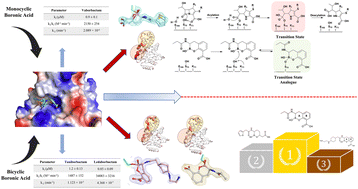
Bicyclic boronic acids inhibit SME-1 carbapenemase via a unique π–π stacking with His105 and covalent interaction with Ser70. Ledaborbactam shows the strongest inhibition, with the lowest ki and enhanced structural stability. X-ray crystallography and molecular dynamics reveal key features helpful in structure-based optimization of boronates targeting class A β-lactamases.

Beta-lactams remain the largest class of antibiotics available today.1 Their safety as a drug and efficacy for treating infections caused by Gram-negative pathogens remain among the best in antibiotics. However, their efficacy has been challenged by Gram-negative pathogens that produce beta-lactamases.2 These enzymes act by cleaving the beta-lactam ring, rendering them inactive for targeting the bacterial cell wall and developing antimicrobial resistance. Beta-lactamases are of two types, serine-based and metallo beta-lactamases.3 Among them, serine-type beta-lactamases remain among the most diverse enzymes, consisting of class A, C, and D. Class A and D can even cleave carbapenems, the last resort antibiotics for severe infections.4 Boronic acids have emerged as potent compounds for tackling the antimicrobial resistance caused by β-lactamases.5 SME-1 is an enzyme from Serratia marcescens that has been increasingly found in NICUs (neonatal intensive care units).6–9 SME-1 confers resistance to all beta-lactams, including carbapenems.10 Understanding the binding of boronic acids against this enzyme will be helpful in determining the resistance mechanisms and future structure-based drug design against the class A carbapenemases. Boronates act as reversible inhibitors,11 where the boron atom mimics the carbonyl carbon in the acyl enzyme complex formed by beta-lactams with serine-type beta-lactamases. This transition state analogue is stable and can reversibly inhibit the enzyme.12 Cyclic boronic acids inhibit SME-1 via a conserved covalent mechanism, wherein the active site Ser70 performs a nucleophilic attack on the boron centre, resulting in the formation of a tetrahedral boronate complex that resembles the high-energy intermediate of β-lactam hydrolysis (Fig. 1A). Although covalent boron adduct formation is a well-established feature of boronate-based inhibitors, the influence of side-chain substituents and the surrounding ring scaffolds on their inhibitory potency and binding dynamics remains insufficiently understood. In this study, we successfully captured and resolved the crystallographic structures of SME-1 covalent adducts formed with vaborbactam, taniborbactam, and ledaborbactam13 (Table S1 and Fig. 1E–G), providing direct evidence of distinct boron coordination geometries and scaffold-dependent binding orientations.
image file: d5ob01703c-f1.tif
Fig. 1 Mechanism of inhibition of cyclic boronic acids with class A carbapenemases. (A) Two-step reversible inhibition mechanism of cyclic boronic acids with class A carbapenemases. Structure of vaborbactam (B), taniborbactam (C), and ledaborbactam (D). 2FoFc electron density maps of vaborbactam (E, PDB ID: 9 W7N), taniborbactam (F, PDB ID: 9 W7O), and ledaborbactam (G, PDB ID: 9 W7P) bound to SME-1, contoured at 1σ.

In every instance, distinct continuous 2FoFc omit density validated the establishment of a covalent bond between catalytic Ser70 and boronic acid. Vaborbactam (Fig. 1E), a monocyclic boronic acid, displays dual conformation, indicating conformational flexibility outside the core binding site. Taniborbactam (Fig. 1F), a bicyclic boronate, has enhanced core density yet exhibits partial disorder at the cyclohexyl ring, indicative of side chain flexibility. Ledaborbactam (Fig. 1G) demonstrates consistently well-defined electron density across the bicyclic framework, indicating a stable and completely organized conformation. To enhance our understanding of the inhibitory mechanism, we examined the non-covalent interactions that stabilize the covalent complexes of SME-1 with vaborbactam, taniborbactam, and ledaborbactam (Fig. 2A–F). Vaborbactam (Fig. 2A and D) interacts with SME-1 by hydrogen interactions with critical residues of the catalytic triad, Ser130 (2.7 Å), Lys73 (3.6 Å), and Glu166 (3.0 Å), thereby stabilizing the covalent boronate–serine adduct. Additional H-bonds are observed with Thr235 and Lys234. Nonetheless, the connections are confined, exhibiting a comparatively elongated shape and a reduced number of distal contacts. The interaction network demonstrates moderate binding stability, aligning with its reduced binding affinity. Taniborbactam (Fig. 2B and E) demonstrates a broader interaction profile. The bicyclic scaffold facilitates effective hydrogen bonding with Ser130 (2.7 Å), Lys73 (3.4 Å), and Glu166 (3.2 Å), in addition to secondary shell contacts with Asn170, Asn132, and Arg221. Furthermore, a hydrophobic and π–π stacking contact is noted between the aromatic moiety of taniborbactam and the imidazole ring of His105 (∼3.6 Å), which enhances active site anchoring and enthalpic stabilization. But the long side chain protrudes outwards in the active site, which enhances the entropy, thereby reducing the binding affinity. Ledaborbactam (Fig. 2C and F) establishes the most extensive and geometrically restricted network of hydrogen bonds. It interacts with three catalytic residues: Ser130 (2.8 Å), Lys73 (2.7 Å), and Glu166 (3.2 Å) alongside hydrogen bonds from Asn170, Arg221, Thr235, and Ser237 (Fig. 2C and F). A π–π stacking contact with His105 further stabilizes the adduct. The crystal structure revealed that the bicyclic core of ledaborbactam and taniborbactam formed a π–π interaction with the His105 of the enzyme, which was absent in the case of vaborbactam, as it lacks ring B (Fig. 1B).


image file: d5ob01703c-f2.tif
Fig. 2 Binding interactions of boronic acid-based inhibitors with SME-1. 3D binding poses of (A) vaborbactam (PDB ID: 9 W7N), (B) taniborbactam (PDB ID: 9 W7O), and (C) ledaborbactam (PDB ID: 9 W7P) within the active site of SME-1, highlighting key hydrogen bonds and π–π contacts. (D–F) 2D interaction diagrams of the corresponding complexes with SME-1, showing specific residue interactions for (D) vaborbactam, (E) taniborbactam, and (F) ledaborbactam. Hydrogen bonds are shown as dashed lines. Ledaborbactam demonstrates the most extensive interaction network involving residues Ser70, Ser130, Ser237, and Lys234 and a π–π stacking with His105.

Thus, bicyclic boronic acids appear to have additional stabilizing interactions compared to the monocyclic ones, and the shorter side chain of ledaborbactam gives it a better fit than taniborbactam. The thermodynamic and kinetic parameters show the inhibitory patterns of vaborbactam, taniborbactam, and ledaborbactam against SME-1. All three inhibitors demonstrate low micromolar apparent inhibition constants (ki), with ledaborbactam exhibiting the strongest inhibition (0.85 µM), followed closely by vaborbactam (0.9 µM) and taniborbactam (1.2 µM) (Table 1). Isothermal titration calorimetry (ITC) (Fig. S1) demonstrated that vaborbactam and taniborbactam bind to SME-1 with ΔG values of −8.54 and −7.76 kcal mol−1, respectively (Table 2). Vaborbactam accomplishes this by a very low entropy of the system (−TΔS = –5.79 kcal mol−1) despite a small enthalpy (ΔH = −2.75 kcal mol−1), suggesting an entropy-driven binding mechanism. Conversely, taniborbactam demonstrates a more advantageous ΔH value (−9.39 kcal mol−1), although it exhibits a very high entropy for the system (+1.63 kcal mol−1), which aligns with the high conformational flexibility of the long side chain. The kinetic assessment of borylation (k2/ki) and deborylation rates (k−2) further differentiates the stability of the covalent enzyme-inhibitor complexes. Ledaborbactam had the lowest k−2 (4.37 × 10⁻⁷ min−1) and highest borylation (34[thin space (1/6-em)]083 M−1 min−1), signifying the greatest kinetic stability of the covalent complex. Vaborbactam exhibited modest deborylation (2.09 × 10⁻⁶ min−1) and low borylation (2150 M−1 min−1), but taniborbactam dissociated at a significantly higher rate (1.12 × 10⁻⁵ min−1), and the rate of borylation was the lowest (1487 M−1 min−1).

Table 1 Kinetic parameters of SME-1 with the cyclic boronates
Boronate K i (µM) k 2/Ki (M−1 min−1) k −2 (min−1)
Vaborbactam 0.9 ± 0.1 2150 ± 254 2.089 × 10⁻⁶
Taniborbactam 1.2 ± 0.13 1487 ± 152 1.123 × 10⁻⁵
Ledaborbactam 0.85 ± 0.09 34[thin space (1/6-em)]083 ± 3216 4.368 × 10⁻⁷


Table 2 Thermodynamic binding parameters for SME-1 inhibition determined by isothermal titration calorimetry (ITC)
Parameters Vaborbactam Taniborbactam
N (sites) 0.97 0.7
K D (M) 5.50 × 10⁻⁷ 2.06 × 10⁻⁶
ΔH (kcal mol−1) −2.75 −9.39
ΔG (kcal mol−1) −8.54 −7.76
TΔS (kcal mol−1) −5.79 1.63


Ledaborbactam's bicyclic core facilitates a tight fit and optimizes enthalpy, and taniborbactam's side chain flexibility results in both thermodynamic and kinetic drawbacks. The integrated analysis of ki, ΔG, k2/ki, and k−2 demonstrates a coherent hierarchy in inhibitor efficacy, with ledaborbactam presenting the most advantageous thermodynamic and kinetic characteristics for SME-1 inhibition.

In the disk diffusion assay, the addition of inhibitors notably enhanced the antibacterial activity of the tested β-lactam antibiotics: ampicillin, imipenem, cephalothin, and cefotaxime against E. coli TOP10 expressing SME-1 (Table S2 and Fig. S2, S3). Cephalothin showed no zone of inhibition (0 mm) against E. coli TOP10 carrying a recombinant plasmid vector (RPV) encoding the SME-1 carbapenemase and exhibited restored activity when combined with vaborbactam (17 mm), taniborbactam (14 mm), and ledaborbactam (18 mm). Similar enhancements were observed for ampicillin (from 12 mm to 20–22 mm), imipenem (from 18 mm to 22–27 mm), and cefotaxime (from 18 mm to 27–29 mm) with the respective inhibitors (Table S2). Among the three, ledaborbactam produced the largest zones of inhibition across most antibiotics. These findings were further supported by MIC assays (Table S1). The SME-1-expressing strain showed high resistance, with MIC values of 32 µg mL−1 for ampicillin and cefotaxime and >128 µg mL−1 for cephalothin. Inhibitor addition reduced these values: ledaborbactam reduced the MICs for ampicillin, imipenem, cephalothin, and cefotaxime to 4, 0.12, 4, and 0.12 µg mL−1, respectively (Table S2). Taniborbactam and vaborbactam also lowered the MIC values, though to a lesser extent. Ledaborbactam exhibited the most consistent and potent restoration of β-lactam activity against the SME-1-producing strain, indicating its potential as an effective β-lactamase inhibitor for class A carbapenemases (Table S2 and Fig. S3). Similar results were obtained from FESEM (Fig. S4). All the experimental data were further supported by molecular dynamics simulations, taking crystal structures of complexes of SME-1. RMSD profiles (Fig. 3A and Fig. S5) showed that the SME-1–ledaborbactam complex (blue) remained highly stable throughout the 500 ns trajectory, with fluctuations confined within ∼0.12 nm. In contrast, SME-1 bound to vaborbactam (black) exhibited significantly higher deviations, increasing beyond 0.25 nm after 400 ns, while the taniborbactam complex (red) displayed intermediate stability (∼0.18 nm). The probability distribution of backbone RMSDs (Fig. 3B) further supports these observations as ledaborbactam has a sharp and narrow peak, indicating conformational rigidity, whereas broader distributions were observed for taniborbactam and vaborbactam with increased flexibility. To assess ligand positioning relative to the catalytic residue, RMSD values were also calculated for the Ω-loop (Fig. 3C). Ledaborbactam again showed the most stable interaction, with values centered around 0.10 nm. Taniborbactam maintained moderate stability (∼0.15 nm), while vaborbactam fluctuated substantially (∼0.22–0.25 nm), suggesting weaker binding at the active site (Fig. 3D). B-factor analysis (Fig. 4A, B and D) and RMSF plots (panel C) revealed distinct flexibility profiles in the Ω-loop (residues 164–179, highlighted in orange). Similar results were obtained for Rg (Fig. S6) and SASA (Fig. S7). Among the three, ledaborbactam (blue) induces the greatest stabilization of these regions, followed by taniborbactam (red), whereas vaborbactam (black) shows higher fluctuations. These trends are consistent with the B-factor and clustering analysis, where ledaborbactam-bound SME-1 maintains a more compact active-site architecture compared to vaborbactam (Fig. S8). The interatomic distance between the catalytic His105 centroid and the centroid of the aromatic ring of taniborbactam and ledaborbactam (panel E) further underscores the differential binding stability (Tables S3 and S4). Ledaborbactam maintains a consistently short distance (∼0.5–0.6 nm), indicative of a stable π–π interaction, but taniborbactam showed higher fluctuations in π–π stacking (Fig. 4E). These trends collectively indicate that ledaborbactam confers enhanced structural stabilization of SME-1, both at the global and active-site levels, correlating with its superior inhibitory behavior.


image file: d5ob01703c-f3.tif
Fig. 3 Molecular dynamics analysis of SME-1 bound to vaborbactam (black), taniborbactam (red), and ledaborbactam (blue). (A and C) Backbone and Ω-loop RMSD profiles over 500 ns simulations. (B and D) Corresponding probability distributions of RMSD values.

image file: d5ob01703c-f4.tif
Fig. 4 B-factor analysis of vaborbactam (A), taniborbactam (B), and ledaborbactam (D). (C) RMSF analysis of all three boronates: black (vaborbactam), red (taniborbactam), and blue (ledaborbactam). (E) π–π stacking distance of the aromatic ring's centroid of taniborbactam (red) and ledaborbactam (blue) with His105's imidazole ring centroid.

Our integrated approach clearly demonstrates how boronates interact with SME-1 carbapenemase and especially how the bicyclic boronic acids, particularly ledaborbactam, strongly inhibit class A carbapenemases. Covalent binding, wide-ranging interaction networks, and active site stabilization are the reasons for their potency. The shorter side chain of ledaborbactam improves thermodynamic and kinetic stability and allows for a better fit and π–π stacking with His105. These results are supported by molecular dynamics simulations, which show that active-site elements, particularly the catalytic loop, have become much more stable with ledaborbactam. These findings show that structurally modified bicyclic boronates can inhibit β-lactamases and offer helpful guidance for future drug development that targets class A carbapenemases.

Conflicts of interest

There are no conflicts to declare.

Data availability

All data supporting the findings of this study are available within the article and its supplementary information (SI). Supplementary information is available. See DOI: https://doi.org/10.1039/d5ob01703c.

Acknowledgements

This work was supported by ICMR (EM/Dev/IG/20/0773/2023), BRNS (54/14/03/2023-BRNS), Intramural funding (CD/2023/IIRP-2023-0000072), and DBT Translational and Structural Bioinformatics-BIC (BT/PR40141/BTIS/137/16/2021).

References

  1. L. Balsalobre, A. Blanco and T. Alarcón, in Antibiotic Resistance: Mechanisms and New Antimicrobial Approaches, ed. J.-L. Capelo-Martínez and G. Igrejas, Wiley, 2019, ch. 3 Search PubMed .
  2. S. Ghafourian, N. Sadeghifard, S. Soheili and R. Sekawi, Curr. Issues Mol. Biol., 2015, 17, 11–22 Search PubMed .
  3. B. G. Hall and M. J. Barlow, J. Antimicrob. Chemother., 2005, 55, 1050–1051 CrossRef CAS PubMed .
  4. T. Naas, L. Dortet and B. I. Iorga, Curr. Drug Targets, 2016, 17, 1006–1028 CrossRef CAS PubMed .
  5. I. E. Crompton, B. K. Cuthbert, G. Lowe and S. G. Waley, Biochem. J., 1988, 251, 453–459 CrossRef CAS .
  6. M. Robert, M. Leterrier-Plong, L. Bouard, C. Chantereau-Jansen, L. Dortet, C. Emeraud and E. M. Takoudju, J. Antimicrob. Chemother., 2025, 80, 1457–1461 CrossRef CAS .
  7. J. Creighton, T. Anderson and J. Howard, J. Antimicrob. Chemother., 2018, 73, 2900–2901 CrossRef PubMed .
  8. W. Sougakoff, L. L'Hermite, T. Pernot, T. Naas, V. Vuillet, P. Nordmann, V. Jarlier and J. Delettre, J. Antimicrob. Chemother., 2002, 50, 267–274 Search PubMed .
  9. F. L. Mata, D. A. Boyd, J. Delport, M. Hoang, L. Imperial, M. Lefebvre, P. Kuhn, B. Van Caeseele, B. M. Willey and M. R. Mulvey, J. Antimicrob. Chemother., 2014, 69, 1825–1829 CrossRef .
  10. J. Speiser, V. Mehta and P. A. Schreckenberger, Am. J. Clin. Pathol., 2012, 138(Suppl. 1), A062 CrossRef .
  11. M. Biagi, A. Shajee, A. Vialichka, M. Jurkovic, X. Tan and E. Wenzler, Antimicrob. Agents Chemother., 2020, 64, e02255–e02219 CAS .
  12. W. Ke, J. M. Sampson, C. Ori, F. Prati, S. M. Drawz, C. R. Bethel, R. A. Bonomo and F. van den Akker, Antimicrob. Agents Chemother., 2011, 55(1), 174–183 CrossRef CAS .
  13. R. E. Trout, A. Zulli, E. Mesaros, R. W. Jackson, S. Liu, J. B. Hamrick, D. Daigle, C. L. Chatwin, K. John, L. McLaughlin, S. M. Cusick, W. J. Weiss, M. E. Pulse, D. C. Pevear, G. C. Moeck, L. Xerri and C. J. Burns, J. Med. Chem., 2021, 64(14), 10155–10166 CrossRef CAS PubMed .

This journal is © The Royal Society of Chemistry 2026
Click here to see how this site uses Cookies. View our privacy policy here.