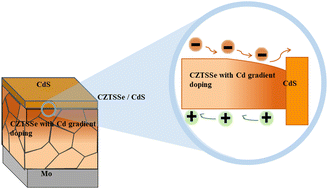
The main bottleneck in the development of kesterite Cu2ZnSn(S,Se)4 (CZTSSe) solar cells is their very low VOC due to severe carrier recombination. Specifically, due to the poor defect environment and unfavorable band structure, carrier recombination at the front interface is considered to be one of the most serious issues. Thus, to reduce the interface recombination and VOC deficit, we propose a convenient and effective strategy for Cd gradient doping near the front interface during selenization. The formed Cd gradient significantly reduced the CuZn defects and related [2CuZn + SnZn] defect clusters near the CZTSSe–CdS heterojunction, thus significantly suppressing the interface recombination near the heterojunction. Benefitting from the formed Cd gradient, a champion device with 12.14% PCE was achieved with the VOC significantly improved from 432 mV to 486 mV. The proposed element gradient doping strategy can offer a new idea for selenization and element gradient doping in other photoelectric devices.