


Harnessing structural disorder: amorphous–crystalline heterostructures as a platform for next-generation photocatalysis

Abstract
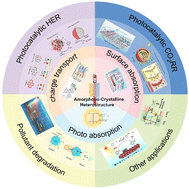
Interface engineering of heterostructures has emerged as a powerful and versatile approach for effectively modulating physicochemical properties and thereby enhancing photocatalytic performance in diverse energy and environmental applications. In particular, the amorphous–crystalline heterostructures have gained increasing interest in recent years for their remarkable ability to integrate the distinct advantages of both ordered and disordered phases within a single architecture. The amorphous phase introduces a wealth of dangling bonds, unsaturated coordination sites, and isotropic structural characteristics, while the crystalline component offers enhanced electronic conductivity and greater thermodynamic stability; these characteristics are synergistically combined in the heterostructure. Furthermore, the intrinsic atomic-level disorder and band alignment at the amorphous–crystalline interface can collectively extend the light absorption spectrum, induce the formation of covalent bonds and a built-in electric field to aid charge carrier transport, and introduce numerous defects that serve as additional active sites for enhanced catalytic performance. Motivated by these intriguing features, this review presents an in-depth analysis of the recent advancements in amorphous–crystalline heterostructure photocatalysts-from synthetic methods to multifaceted applications. Initially, we describe representative fabrication strategies for constructing amorphous–crystalline heterostructures, including hydrothermal/solvothermal methods, deposition techniques, electrostatic assembly, as well as precipitation and calcination routes. Subsequently, we highlight the advantages and recent milestones of these heterostructures as highly effective photocatalysts for hydrogen evolution, carbon dioxide reduction, and pollutant degradation. At the end of this review, future perspectives and challenges are discussed to inspire the continued development of amorphous–crystalline heterostructures toward efficient and sustainable clean energy technologies.
- This article is part of the themed collections: Journal of Materials Chemistry A Recent Review Articles and Advances in Sustainable Catalysis: from Materials to Energy and Environmental Applications
 Please wait while we load your content...


