


Research progress on efficient and selective transition metal oxides for photoelectrochemical seawater splitting

Abstract
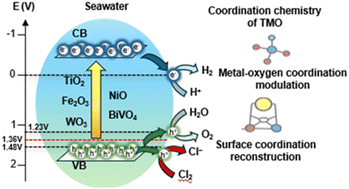
Harnessing solar energy through photochemical processes in seawater offers a promising path toward sustainable hydrogen production. Photoelectrochemical (PEC) seawater splitting combines light-driven charge separation with abundant water resources to generate hydrogen fuel. This review highlights recent progress in transition metal oxide (TMO) photoanodes and nickel (Ni)-based cocatalysts, focusing on the interplay of light absorption, charge transport, surface coordination chemistry, and catalytic selectivity. Representative TMOs, including titanium dioxide (TiO2), tungsten trioxide (WO3), hematite (Fe2O3), and bismuth vanadate (BiVO4), are evaluated for optoelectronic properties, stability, and performance limitations. TiO2 exhibits excellent photochemical stability but limited visible-light response (<1 mA cm−2). WO3 and Fe2O3 extend light absorption, reaching ∼6 and ∼4 mA cm−2, respectively, though both face charge recombination and stability challenges. BiVO4 with a 2.4 eV bandgap, currently shows the best balance, achieving 4–7 mA cm−2 at 1.23 V vs. RHE when coupled with protective layers and cocatalysts. Meanwhile, NiMo- and NiFe-based cocatalysts offer cost-effective enhancement of interfacial charge transfer and corrosion resistance. By adopting a coordination-chemistry-centered perspective, this review links defect structures, surface electronic states, and interfacial pathways to PEC performance, highlighting strategies to improve durability, selectivity, and scalability for practical seawater hydrogen production.
- This article is part of the themed collections: Journal of Materials Chemistry A Recent Review Articles and Advances in Sustainable Catalysis: from Materials to Energy and Environmental Applications
 Please wait while we load your content...


