


Copper-based semiconductor nanocrystals for optical applications
 *abc
Patrizia
Canton
af
*abc
Patrizia
Canton
af
Abstract
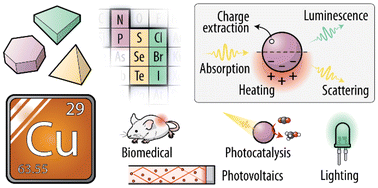
Copper-based semiconductor nanocrystals (SNCs) are a broad class of nanomaterials that include pnictogenides, chalcogenides, and halides. The breadth of compositions, crystal structures, and electronic properties displayed by these SNCs is reflected in their rich photophysics, which can underpin strong photon absorption capabilities, efficient (photo)luminescence, and plasmonic behavior. Because of this optical versatility, copper-based SNCs have been proposed for applications in fields such as photovoltaics, sensing, bioimaging, and photocatalysis, in some cases reaching the level of commercialization. In this review, we provide an up-to-date overview of the research on these nanomaterials with optical properties of outmost technological relevance. After a brief introduction on light-(nano)matter interaction, we individually discuss pnictogenides, chalcogenides, and halides, pinpointing structure–property relationships, identifying the most common synthesis approaches, and highlighting cases of application we consider particularly relevant or novel. Lastly, we outline outstanding challenges, with the hope of spurring the ingenuity and curiosity of researchers towards the next discoveries in this multicoloured and multifaceted field.
- This article is part of the themed collections: Recent Review Articles and Quantum nanomaterials
 Please wait while we load your content...


