


Comparative review of laboratory approaches for simulating and characterizing aerosol emissions from open biomass burning

Abstract
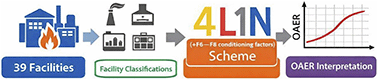
Open biomass burning (BB) is a major global source of atmospheric particulate matter, yet laboratory studies often report divergent aerosol aging outcomes that are difficult to compare across experiments. While this variability is frequently attributed to fuel properties or oxidation conditions, the influence of the laboratory facility architecture and smoke-conditioning design has not been systematically evaluated. To address this gap, this review develops a structured framework for comparing laboratory BB aerosol facilities, informed by an analysis of 39 facilities reported in the literature. This framework integrates a nine-category structural classification with a concise encoding of consistently reported smoke-conditioning features, and it is complemented by a working hierarchy to evaluate the relative importance of facility-conditioning factors. Organic aerosol mass enhancement is employed as a representative and widely reported outcome metric to evaluate and illustrate the interpretive value of the framework, using a combination of qualitative synthesis and semi-quantitative trend analysis. The analysis indicates that facility design choices, particularly those governing smoke handling and conditioning prior to the first measurement, which define the initial smoke state, systematically influence the reported OA mass enhancement and can, in many cases, exert a stronger effect than the aging environment itself. Beyond OA mass enhancement, the framework clarifies key design trade-offs among existing laboratory configurations, improves the cross-study comparability, and provides practical guidance for the design and interpretation of future BB aerosol experiments.
- This article is part of the themed collection: Environmental Science: Atmospheres Recent Review Articles
 Please wait while we load your content...


