


X-ray absorption spectroscopy perspective on electronic structure and catalysis of metal oxide heteronanostructures
 *c
and
Chung-Li
Dong
*a
*c
and
Chung-Li
Dong
*a
Abstract
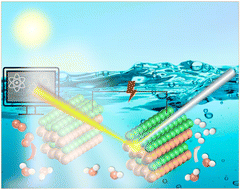
Nanostructured metal oxides are versatile materials with broad applications in energy conversion and (photo)(electro)catalysis for crucial processes such as water splitting for green hydrogen production and carbon dioxide reduction to value-added chemicals and solar fuels. Although extensive studies have reported enhanced catalytic performance, a comprehensive atomic-scale understanding that correlates nanostructure, electronic structure, and catalytic functionality remains limited. This mini-review focuses on the application of X-ray Absorption Spectroscopy (XAS), including ex situ and in situ approaches, as a powerful tool for investigating modified semiconducting oxides at the electronic and atomic levels. XAS provides direct insights into electronic structures, local coordination environments, orbital hybridization, and interfacial charge-transfer pathways, enabling identification of the catalytically active species and elucidation of structure–activity relationships. The first section discusses how precise nanostructuring and controlled atomic doping (e.g., Nb, Ti, Ta, and Nb/Ta in hematite systems, as well as Co–Pi and Bi in vanadates) modify electronic states and local atomic environments, as revealed by XAS analysis. The second section highlights how heterostructures and interfacial electronic reconstruction, exemplified by TiO2/red phosphorus systems, where charge redistribution plays a critical role in enhancing solar-to-chemical fuel conversion efficiency. The final section addresses oriented α-Fe2O3 nanorods and ZnO/Fe2O3 core–shell nanowires, highlighting the influence of orbital anisotropy in governing photo(electro)catalytic activity. Furthermore, the discussed studies demonstrate how XAS can identify the optimal dopant concentration in Ti-modified hematite, reveal enhanced charge separation in nanopyramidal CoPi/BiVO4 structures driven by internal electric field, detect interfacial hole states induced by Au nanoparticles in α-Fe2O3/Au/TiO2 heterostructures, and probe interfacial charge-transfer processes in ZnO/Fe2O3 core–shell nanowires. In summary, this review highlights the critical role of XAS techniques in establishing atomic-scale correlations between structural modifications and catalytic performance in heterostructured metal oxide systems, providing a rational foundation for designing next-generation, low-cost, and highly efficient photo(electro)catalytic materials for sustainable solar-to-chemical energy conversion.
- This article is part of the themed collection: Recent Review Articles
 Please wait while we load your content...


