


 PLATFORM UPDATE:


Looping-accelerated CO2 mineralization for cost-competitive cementitious materials and hydrogen
 *ac
*ac
Abstract
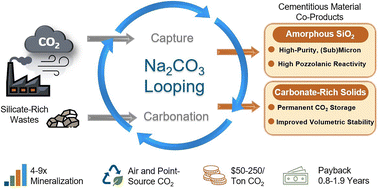
Advancing a net-negative carbon economy requires efficient and cost-effective CO2 capture and utilization methods. Here, we introduce a novel sodium carbonate (Na2CO3) looping process that accelerates CO2 capture and mineralization by silicate feedstocks such as steel slags, producing a carbonate-rich product and amorphous silica as cementitious materials. Unlike conventional direct or acid-assisted mineralization, our chemical looping approach first carbonates the silicate using a Na2CO3 solution. The resulting solution then reactively captures CO2 and precipitates high-purity, (sub)micron-sized amorphous silica, while simultaneously regenerating Na2CO3. Demonstrated on steel slags, the process achieved 59% and 35% capture for point-source and air CO2, respectively, mineralizing up to 2.79 mmol-C g−1 slag. Compared to traditional slag-water CO2 mineralization, Na2CO3 looping captured and mineralized 4 to 9 times more CO2. Mechanistically, Na2CO3 looping accelerates mineralization by rapidly removing Ca via carbonate precipitation, thereby sustaining a strong thermodynamic driving force for continued Ca–silicate dissolution, which governs the overall carbonation rate. The process offers several key advantages and novelties: (1) no net chemical consumption due to complete Na2CO3 regeneration; (2) CO2 capture and mineralization occur at room temperature and 1 atm; (3) the CO2 source can be either a point source or ambient air; (4) both the carbonation and reactive capture steps are exothermic, lowering system energy demand and eliminating external heat input; and (5) two cementitious products—carbonate-rich solids and amorphous silica—are generated separately, enabling flexible blending in downstream applications. Additionally, utilization of slag waste heat enables its reaction with steam to produce up to 1.01 mmol-H2 g−1 slag. Without product revenues, levelized costs are only $252 and $50 per ton of CO2 for air and point-source capture, respectively; considering product revenues, the payback periods are only 1.9 and 0.8 years for air and point-source CO2.
- This article is part of the themed collections: Energy & Environmental Science Recent HOT Articles and Recent Open Access Articles
 Please wait while we load your content...


