


Glutathione-responsive degradable amphiphilic polyester-based nanocarriers for targeted drug delivery
 *a
*a
Abstract
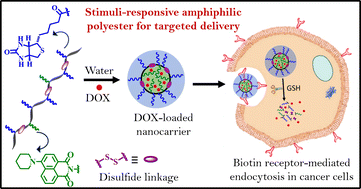
Disulfide bonds have been widely explored in cancer therapeutic applications due to their propensity to break in the presence of a tripeptide, glutathione (GSH), which is over-expressed in cancerous cells due to the upregulation of antioxidant defense pathways. Therefore, the incorporation of disulfide bonds into polymeric nanocarriers designed for anticancer drug delivery facilitates the degradation of the polymer backbone and promotes the release of the encapsulated drug in cancerous microenvironments. However, facile synthetic strategies that incorporate disulfide bonds into biodegradable and biocompatible amphiphilic polyesters for targeted delivery are limited. We have synthesized two such polyesters, P1 and P2, integrating disulfide bonds into the polyester backbone through an organocatalyzed polycondensation reaction between a dipentafluorophenyl-activated ester and functionalized diols in N,N-dimethylformamide at 100 °C. Among these two, P1 is a homopolyester comprising bis(2-hydroxyethyl) disulfide (HEDS), and P2 is a copolyester comprising an additional biotin moiety for cancer cell selectivity and a fluorescent NMI-functionalized moiety for cellular trafficking, randomly distributed in the polymer chain as pendants, along with the disulfide bonds in the backbone. The time-dependent kinetics study during the polytransesterification reaction demonstrates complete monomer conversion within 24 hours. By virtue of its amphiphilic character, P2 self-assembles into nanoaggregates in water with a size of ∼220 nm, and features the propensity to encapsulate the hydrophobic dye Nile red (NR). Degradation of the nanoaggregates and subsequent NR-dye release are illustrated in the presence of both GSH and lipase B. The self-assembled P2 shows selective uptake towards cancerous HeLa cells compared to non-cancerous NIH 3T3 cells by biotin-receptor-mediated endocytosis, enabling its ability to selectively deliver the anticancerous drug, doxorubicin, resulting in decreased cellular viability, yielding an IC50 value of 19 µg mL−1 after 48 hours of incubation. These findings highlight the potential of this versatile methodology for designing structurally new degradable polyesters with tunable functionalities for other target-specific stimuli-responsive therapeutic applications.
- This article is part of the themed collections: Pioneering Investigators 2025 and Polymer Chemistry 15th Anniversary Collection
 Please wait while we load your content...


