


Mitigating volume expansion in alloy-type anodes for potassium-ion batteries: mechanistic insights and material engineering strategies
 *ab
*ab
Abstract
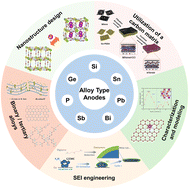
Potassium-ion batteries (PIBs) have emerged as a viable substitute for lithium-ion batteries (LIBs) in large-scale energy storage applications, owing to the abundant natural reserves of potassium, prospective economic benefits, and favorable redox potential of K+/K. The electrochemical properties of PIBs are predominantly governed by their anode materials, with alloy-type anodes exhibiting particular promise because of their multi-electron redox mechanisms, substantial theoretical capacities, appropriate operating voltage, and natural abundance. Nevertheless, the substantial volume variations occurring during electrochemical cycling severely compromise the structural integrity and cycling performance of these alloy-based anodes, thereby limiting their practical implementation. This comprehensive review aims to: (i) identify the principal obstacles impeding the development of alloy-type anode materials for PIBs and (ii) summarize recent progress and innovative fabrication techniques for constructing high-performance alloy anodes. The primary goals are to establish systematic design principles for optimized anode architectures while suggesting potential research directions for developing next-generation anode systems through fundamental mechanistic understanding and advanced material engineering strategies.
- This article is part of the themed collection: Journal of Materials Chemistry A Recent Review Articles
 Please wait while we load your content...


