


Bent alkyne units as active sites: structure–activity correlation in graphdiyne-inspired polymers for photocatalytic hydrogen evolution
 *ab
*ab
Abstract
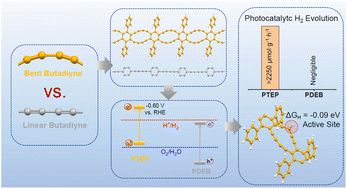
Alkyne bonds are promising for photoelectrocatalysis due to their tunable electronic structure; however, the relationship between their local geometry and photocatalytic function remains unclear. Herein, a graphdiyne-derived polymer featuring curved butadiyne linkages (PTEP) was designed and synthesized, and its photocatalytic performance was compared with that of a linear analogue (PDEB) to elucidate the effect of alkyne bending on hydrogen evolution. PTEP exhibits broad visible-light absorption, suitable band edges, and efficient charge separation, achieving a high H2 evolution rate of >2250 µmol g−1 h−1 with 14.75% quantum efficiency at 420 nm using ascorbic acid as the electron donor and Pt (0.5 wt%) as the co-catalyst, while PDEB shows negligible activity. Density functional theory calculations confirm the bent alkyne carbons in PTEP as the dominant active sites with a lower hydrogen adsorption free energy (−0.09 eV). This work demonstrates that geometric control of alkyne bonds can simultaneously modulate the band structure and expose highly active sites, providing clear guidance on structure–activity relationships for designing efficient alkyne-based photocatalysts.
- This article is part of the themed collection: Advances in Sustainable Catalysis: from Materials to Energy and Environmental Applications
 Please wait while we load your content...


