



Ferroelectricity-tunable MXene-family photocatalysts for overall water splitting
 *c
*c
Abstract
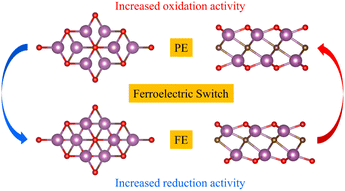
Photocatalytic water splitting is a promising approach to address the global energy crisis by generating renewable and clean energy. Although numerous two-dimensional materials have been explored as potential photocatalysts in recent years, effective strategies for modulating photocatalytic reactions and energy conversion efficiency remain limited. In this study, using first-principles calculations, we demonstrate that photocatalytic activities and energy conversion efficiency can be effectively regulated through ferroelectric–paraelectric phase transitions in MXene family. It has been found that both the ferroelectric and paraelectric phases of Sc2CO2 and Y2CS2 monolayers meet the bandgap and band-edge position requirements for photocatalytic water splitting. In addition, their light absorption properties and solar-to-hydrogen energy conversion efficiency are tunable by ferroelectric switching. Moreover, in the ferroelectric phase, Y2CS2 MXene exhibits higher redox potential and stronger driving capability for the hydrogen evolution reaction via photogenerated electrons. Conversely, its paraelectric phase shows superior performance in promoting water oxidation through photogenerated holes. Our study highlights the critical role of ferroelectric polarization in water splitting and provides a viable pathway for tailoring the photocatalytic properties of two-dimensional ferroelectric materials.
- This article is part of the themed collections: Journal of Materials Chemistry A HOT Papers and Advances in Sustainable Catalysis: from Materials to Energy and Environmental Applications
 Please wait while we load your content...


