


Precision ladder-structured silver cluster assembly bridged by tetrazine linkers for highly sensitive and selective luminescence recognition of amino acids

Abstract
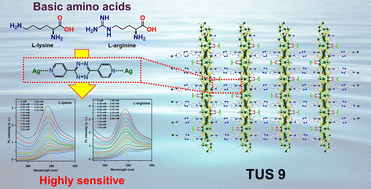
Silver nanoclusters merge atomically defined structures with intense, environment-responsive photoluminescence, yet their notorious lability in air and water has constrained real-world sensing. Here we convert fragility into a design principle by immobilizing a silver nanocluster motif inside a reticularly reinforced, recognition-active lattice. TUS 9 is a ladder-structured silver cluster-assembled material built from bow-shaped Ag13 units that first organize into one-dimensional chains (“rails”) and are then stitched laterally by rigid 3,6-di(4-pyridyl)-1,2,4,5-tetrazine linkers (“rungs”). Single-crystal X-ray diffraction reveals a monoclinic C2/c framework in which argentophilic contacts and a mixed thiolate/trifluoroacetate ligand shell stabilize the cluster scaffold, while directional Ag–N coordination locks interchain registry. Bulk phase fidelity is confirmed by PXRD and XPS, and the ordered packing generates permanent microporosity. In water, TUS 9 retains strong emission with a sensing-ready band at 377 nm (λex = 295 nm), enabling selective luminescence quenching by basic amino acids. L-Lysine and L-arginine produce pronounced Stern–Volmer responses (KSV = 891.7 and 540.1 M−1) with detection limits of 407 and 162 μM, respectively, whereas acidic amino acids perturb the emission only weakly. The response is fully recyclable over 10 cycles and post-sensing XPS shows preserved coordination environments. This work demonstrates that electronically active linkers can simultaneously stabilize silver nanocluster frameworks against aqueous degradation and encode molecular selectivity, opening a modular route to robust, programmable luminescent sensors.
- This article is part of the themed collection: Prof. Amitava Patra's 60th birthday: Current advancements in photonic materials and spectroscopy
 Please wait while we load your content...


