


 PLATFORM UPDATE:

Hole transport material free-NiO-g-C3N4-incorporated methylammonium lead iodide-based perovskite solar cells

Abstract
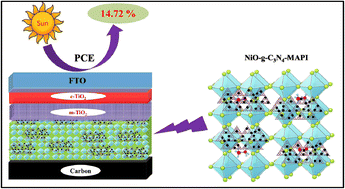
The incorporation of p-type semiconductor materials into perovskites is one of the most preferable methods for improving the perovskite layer quality, suppressing carrier recombination and achieving remarkable photovoltaic performance and stability in perovskite solar cells. Herein, NiO-g-C3N4 nanocomposites are incorporated with a methylammonium lead iodide (MAPI) precursor to assist in the formation of a high-quality perovskite layer with large grains and fewer defects. The incorporation of NiO-g-C3N4 facilitates superior charge generation and charge transfer, reduces recombination at the interface and increases the light harvesting ability by improving the MAPI layer formation and modifying the band position of MAPI. The power conversion efficiency (PCE) of the NiO-g-C3N4-MAPI-based PSC increased from 8% to 14%. The maximum PCE of 14.72% was obtained with improved photovoltaic parameters, i.e., a current density (Jsc) of 22.56 mA cm−2, an open circuit voltage (Voc) of 0.96 V and a fill factor (FF) of 0.68, for the NiO-g-C3N4 (1 : 0.5)-MAPI-based PSC. The NiO-g-C3N4-MAPI-based PSCs showed improved stability after 600 hours of storage in an ambient atmosphere.
 Please wait while we load your content...


