


Pentafluoroethyl(fluoro)phosphate ionic liquids: synthesis and properties
 *a
*a
Abstract
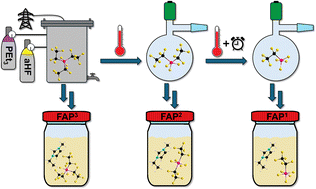
Ionic liquids (ILs) composed of the 1-ethyl-3-methylimidazolium [EMIm]+, 1-butyl-3-methylimidazolium [BMIm]+, or butylmethylpyrrolidinium [Pyr14]+ cation and fluorophosphate anions with three, two, or one pentafluorethyl substituents bonded to phosphorus [mer-(C2F5)3PF3]− (FAP3), [trans-(C2F5)2PF4]− (FAP2), and [(C2F5)PF5]− (FAP1) were synthesized from tris(pentafluorethyl)difluorophosphorane. The FAP ILs were characterized by NMR, IR, and Raman spectroscopy and elemental analysis and the single crystal structures of [EMIm]+ ILs with the anions FAP3, FAP2, and FAP1 and of [BMIm]FAP1 were elucidated. The thermal, physicochemical, and electrochemical properties of the ionic liquids were investigated. [BMIm]FAP2 has the lowest dynamic viscosity and the highest specific conductivity among the series of [BMIm]+ ILs making it a promising IL for different applications. The interpretation of the data was aided by results from density functional theory (DFT) calculations. Evaluation of structural, spectroscopic, and theoretical data showed the weakly coordinating nature of the series of phosphate anions to increase in the order of [PF6]− < FAP1 < FAP2 < FAP3. The influence of the size, shape, flexibility and the coordinative behavior of the three FAP anions and the hexafluorophosphate anion on the ionic liquid properties was assessed.
- This article is part of the themed collection: Celebration of the 70th birthday of Prof. Giuseppe Resnati
 Please wait while we load your content...


