


Microwave-assisted drying kinetics of cocoa pod husk (Theobroma cacao L.): physicochemical, techno-functional and phytochemical analysis

Abstract
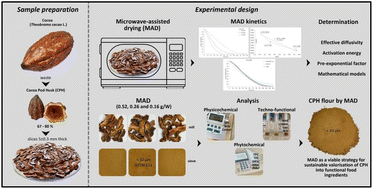
This study explored microwave-assisted drying (MAD) as a sustainable strategy for the valorisation of cocoa pod husk (CPH), an important agro-industrial by-product. Drying kinetics were described using a Fick-based diffusion model for flat geometry, while the effective diffusivity (Deff) was modelled as a function of the mass-power ratio expressed in grams per watt (g W−1) using a modified Arrhenius equation, which allowed the kinetic parameters Deff, activation energy (Ea) and pre-exponential factor (D0) to be estimated to elucidate moisture transport under microwave irradiation. Moisture transfer followed Fick's law, with an exponential increase in Deff (3.74 × 10⁻⁷ to 7.44 × 10⁻⁷ m2 s−1) as g W−1 decreased. The Arrhenius fit (R2 = 0.93) yielded a low Ea (14.94 kJ mol−1) and D0 (9.23 × 10⁻⁷ m2 s−1), consistent with the experimental range, confirming efficient volumetric heating. Page's model provided the best fit (R2 = 0.99). The physicochemical properties (pH, °Brix) remained stable, while MAD conditions significantly influenced the functional and colour parameters, where higher powers reduced water retention capacity, but increased solubility and induced colour changes from reddish (0.26 g W−1) to yellowish (0.16 g W−1) tones. From a phytochemical point of view, the mildest condition (0.52 g W−1) achieved the highest retention of phenols (TPC), flavonoids (TFC), and antioxidant activity (FRAP, DRSC, ARSC), while excessive power caused degradation. Overall, MAD proved to be an efficient, controllable, and environmentally friendly technique for producing high-value CPH flour (<53 µm), supporting its potential application in functional and nutraceutical formulations within the sustainable valorisation of cocoa by-products.
 Please wait while we load your content...


