


Nanoclusters formed by gas-phase condensation and their size-dependent properties

Abstract
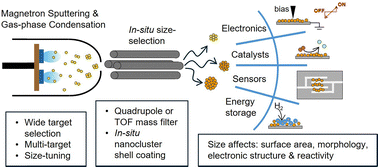
The study of nanoclusters (NCs) has provided invaluable insights into the interactions among small assemblies of atoms, where their size encapsulates vital information about atom–atom synergies that govern morphology, defects, and electronic states. The precise tuning of NC size has become a pivotal factor in optimizing their performance. Evolving in tandem with other ultra-high vacuum (UHV) techniques over recent decades, the gas-phase condensation technique has emerged as a remarkable approach to synthesize solvent-free and ligand-free NCs with tailored size distributions. This review provides a dual focus on the formation and size control of NCs through the gas-phase condensation technique, elucidating its advantages and limitations primarily through the use of magnetron-based sputtering sources, as well as on the size-dependent physical, chemical and electronic properties of NCs in their diverse applications. The capacity to engineer NCs with precision down to the number of atoms has ushered in a new era of transformative impacts on chemistry, materials science, and beyond. The precise control of NC size and composition has opened new opportunities for tailoring their size-specific properties for specific applications, thereby harnessing their full potential to meet the grand challenges of the rapidly evolving world of nanotechnology.
- This article is part of the themed collection: ChemComm Nanocatalysis
 Please wait while we load your content...


