


 PLATFORM UPDATE:


Strain-modulated exciton dynamics and optical nonlinearity in two-dimensional Pt-based semiconductors

Abstract
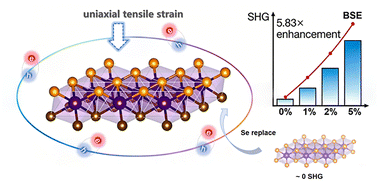
Tunable optical responses are essential for next-generation photonic devices, and strain engineering provides an effective route for achieving such tunability in two-dimensional (2D) materials. However, how strain modulates excitonic effects and nonlinear optical responses in 2D systems remains poorly understood, especially in the presence of strong electron–hole interactions. Here, we investigate monolayer PtS2 and Janus PtSSe under uniaxial tensile strain using first-principles GW and Bethe–Salpeter equation (BSE) calculations. We find that strain does not merely shift the quasiparticle band gap, but also renormalizes exciton binding energies, reshapes real-space exciton wavefunctions, and redistributes oscillator strength. As a direct consequence, the second-order nonlinear susceptibility (χ(2)) exhibits pronounced excitonic resonance features that evolve strongly with strain. The radiative lifetime (τ) shows a nonmonotonic strain dependence that closely follows the exciton transition dipole moment in both systems. In Janus PtSSe, electron–hole interactions enhance the SHG coefficient by a factor of 5.83 under 5% strain relative to the independent-particle approximation (IPA). These results reveal a unified picture in which intrinsic symmetry breaking and strain-driven exciton reconfiguration jointly govern χ(2), establishing Janus PtSSe as a strain-programmable platform for exciton-mediated nonlinear optics.
 Please wait while we load your content...


