


Silicon–PEDOT:PSS hybrid heterojunction solar cells: potential, recent developments and challenges
 ab
Diksha,
ab
Riya
Bansal,
ab
Urvashi
Punia,
ab
Prathap
Pathi
ab
and
Sanjay K.
Srivastava
*ab
ab
Diksha,
ab
Riya
Bansal,
ab
Urvashi
Punia,
ab
Prathap
Pathi
ab
and
Sanjay K.
Srivastava
*ab
Abstract
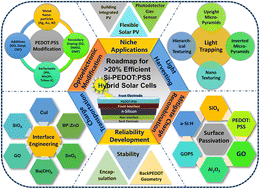
The growing global demand for sustainable energy has established solar power as a critical renewable energy solution. In recent years, substantial research efforts have been dedicated to advancing solar power conversion technologies, accelerating the expansion of the photovoltaic (PV) market. While crystalline silicon (Si) solar cells remain the industry standard, their high production costs pose a barrier to widespread adoption. This limitation has driven interest in the concept of hybrid solar cells, particularly organic-silicon heterojunction solar cells (HSCs), which combine the high efficiency and technological maturity of silicon with the low-temperature processability and tunable optoelectronic properties of the organic semiconductors. The HSCs based on Si-poly(3,4-ethylenedioxythiophene):polystyrene sulfonate (PEDOT:PSS) have attracted significant research attention towards the development of efficient and cost-effective hybrid PV devices in the last decade. This review explores the recent progress in Si-PEDOT:PSS based HSCs, focusing on their potential and strategies to enhance their performance, including (i) surface structuring of silicon to improve light trapping and absorption, (ii) engineering the inorganic–organic interface to aid charge separation and extraction, (iii) employing surface passivation techniques to minimize recombination losses, (iv) optimizing the backPEDOT:PSS geometry, (v) modifying the PEDOT:PSS layer properties, and (vi) enhancing the stability of Si-PEDOT:PSS hybrid heterojunction cells. It also covers the key advances in the flexible Si-PEDOT:PSS HSCs utilizing flexible thin Si wafers. This review also assess the challenges of the HSC device concept along with future prospects. Thus, this review aims to bridge existing knowledge gaps and offer insights into the future development of Si-PEDOT:PSS, serving as both a comprehensive resource for researchers and a foundation for innovative approaches in next-generation hybrid photovoltaics.
- This article is part of the themed collection: Journal of Materials Chemistry C Recent Review Articles
 Please wait while we load your content...


