


 PLATFORM UPDATE:


Exploring structure–function synergy in multi-fused A–D–A systems for advanced organic electronics
 *c
Muhammad Salman
Khan,
*d
*c
Muhammad Salman
Khan,
*d
Abstract
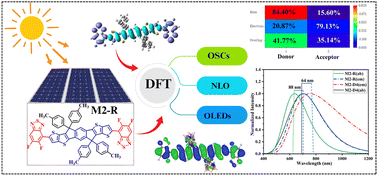
Organic optoelectronic materials are utilized in a wide range of devices such as photovoltaics, light-emitting diodes (OLEDs), thermoelectrics, field-effect transistors, and spintronics. Their intrinsic optoelectronic properties arise from various phenomena in photoexcited states or in electron-pumped charged species, and computational predictions of these properties help researchers design potential electronic materials. To recommend suitable candidates for organic photovoltaic devices, the main objective of this study is to present a thorough investigation of the charge transport and optoelectronic properties of the reference molecule M2-R and a series of five M2-D1–M2-D5 molecules for organic electrical devices. Using DFT and TD-DFT methodologies, we systematically investigated the optoelectronic and photovoltaic properties of the selected molecules, along with key nonlinear optical (NLO) properties and OLED performance. The M2-D4 molecule appeared to outperform all because of its advantageous features, which included the narrowest energy gap (1.95 eV), lowest binding energy (0.226 eV), highest hole extraction potential (6.48 eV), longest charge transfer length (1.14 Å), good open-circuit voltage (1.77 V), greatest average polarizability (2.25 × 10⁻²² esu), and excellent fill factor (92.95%). Additionally, the examined structural, optical, and electronic properties of the investigated molecules indicated that the majority of them demonstrated improved charge transmission and had the potential to deliver high performance for future organic photovoltaics (OPVs).
 Please wait while we load your content...


