


 PLATFORM UPDATE:


Exciton dynamics in the room-temperature luminescent quasi 2D perovskite C10H20(NH3)2PbBr4

Abstract
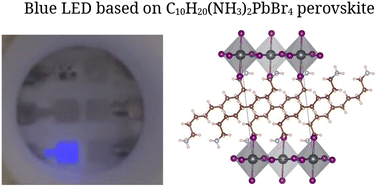
This work explores the electronic and optical properties of the quasi 2D hybrid halide perovskite C10H20(NH3)2PbBr4. According to DFT calculations, it is a direct bandgap semiconductor. The experimental optical bandgap determined from diffuse reflectance spectroscopy equals 3.06 eV. PL emission spectra reveal bands, attributed to free exciton (FE) and self-trapped exciton (STE) states. Temperature-dependent PL spectra show rapid thermal quenching of the STE emission, while the FE emission remains stable up to room temperature demonstrating the FE luminescence flaring up when STE luminescence is quenched. This indicates effective communication between the FE and STE states with a low energy barrier for the STE to FE transition. This high temperature PL emission, dominated solely by the FE emission band is a key finding. To demonstrate its potential, we fabricated a prototype blue LED, based on C10H20(NH3)2PbBr4. The device showed an EQE of 0.016% and a room-temperature PLQY of 6.3%. Given these numbers, significant potential for the performance improvement of the LED is foreseen, making the perovskite a highly promising material for optoelectronics and photonics.
 Please wait while we load your content...


