


 PLATFORM UPDATE:


Reversible polymorph-to-amorphous phase transformation based on an aggregation-dependent thermally activated delayed fluorescence emitter
 *ab
and
Fener
Chen
*abc
*ab
and
Fener
Chen
*abc
Abstract
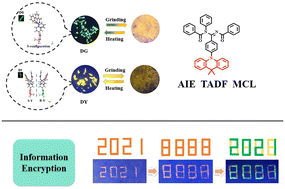
The design of suitable polymorphic thermally activated delayed fluorescence (TADF) emitters is crucial for advancing multifunctional organic luminescent materials. Herein, a unique multifunctional molecule, the benzoimido-benzamide derivative DMAC-PYZ, was synthesized through a green photo-oxidation reaction. This compound exhibited polymorphism (DG and DY), TADF, mechanochromic luminescence (MCL), and aggregation-induced emission (AIE) properties. The DG and DY crystals displayed green and yellow fluorescence, respectively, with delayed fluorescence lifetimes of 65.76 µs (DG) and 0.29 µs (DY). Furthermore, it demonstrated an aggregation-dependent TADF characteristic and MCL behavior in response to mechanical stimuli. Crystal structure and density functional theory (DFT) analysis revealed that the aggregation-dependent TADF originated from variations in the D–A molecular twist angle across different aggregation states. Upon thermal stimulation at 60 °C, amorphous powders of DG and DY reversibly revert to their original crystalline packing structures and emission. These characteristics stemmed from the high stability of crystalline enantiomers. This rare reversible polymorph-to-amorphous phase transition has been successfully applied to information security and encryption. This study presented a novel MCL-active TADF material capable of reversible polymorph-to-amorphous phase transition, elucidating the conformation–property relationship in aggregated states.
- This article is part of the themed collection: Journal of Materials Chemistry C HOT Papers
 Please wait while we load your content...


