


 PLATFORM UPDATE:


An organic near-infrared up-conversion device with photon multiplication photodetection capability

Abstract
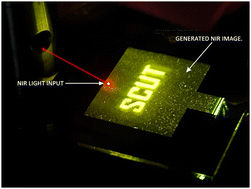
Organic up-conversion devices integrate visible light-emitting diodes and near-infrared photodetectors, offering advantages over traditional near-infrared imaging devices, such as low cost, high resolution, scalability for large-area fabrication, and a simple device structure. This study proposes an organic up-conversion device with dual functions of conventional near-infrared-to-visible light conversion and weak light detection. Leveraging dual-function integration by synergistically enhancing the optical microcavity effect and photoregeneration gain, the device successfully amplifies the weak absorption of intermolecular charge transfer states in the near-infrared region in the rubrene:C70 photosensitive layer, effectively extending the spectral response range to 850 nm and enabling the integration of pixel-free up-conversion imaging and high-gain photodetection. In the up-conversion mode, a clear pixel-free imaging at 780 nm with a photon-to-photon conversion efficiency of 3.57% is achieved. Unlike conventional up-converters, this resulting device can switch to a high-sensitivity detection mode with avalanche multiplication characteristics, exhibiting an external quantum efficiency exceeding 1100%. This research study establishes a new paradigm for constructing multifunctional organic optoelectronic devices, bridging the technological gap between pixel-free near-infrared imaging and ultra-sensitive weak light detection.
 Please wait while we load your content...


