


Structure–property relationships in organic framework materials: the role of linkage modes and building units
 *a
Tai-Bao
Wei
b
*a
Tai-Bao
Wei
b
Abstract
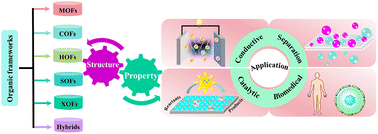
Organic framework materials have attracted extensive attention due to their high structural tunability, diverse functionalities, and excellent structural stability, and have demonstrated great potential for applications in fields such as energy storage, gas separation, catalysis, optoelectronics, and drug delivery. According to differences in linkage modes and constituent units, these materials can be broadly classified into metal–organic frameworks (MOFs), covalent organic frameworks (COFs), hydrogen-bonded organic frameworks (HOFs), supramolecular organic frameworks (SOFs), halogen-bonded organic frameworks (XOFs), etc. The distinct properties and application potentials of framework materials often arise from the choice of building blocks and the nature of their interconnecting bonds. This review systematically introduces, from the perspectives of structure and performance, the development history, main characteristics, and research progress of several typical organic frameworks, and briefly analyzes the advantages and challenges associated with each type. In addition, the formation strategies and structural features of organic framework hybrid materials are briefly discussed. Subsequently, traditional halogen bonds—particularly the [N⋯X+⋯N] type—are described in detail, followed by a summary of the latest research progress on [N⋯X+⋯N]-based XOFs. Furthermore, from an application-oriented perspective, this review highlights the research achievements of organic framework materials in conductivity, catalysis, adsorption–separation, and biomedicine, and elucidates how connection modes and building unit selection influence their properties and functions. Finally, the current development status of various organic framework materials is summarized, and future prospects are discussed, aiming to promote their broader application and continued advancement in multiple fields.
- This article is part of the themed collection: Journal of Materials Chemistry C Recent Review Articles
 Please wait while we load your content...


