


 PLATFORM UPDATE:


Laser-driven interfacial engineering toward robust and stretchable copper–liquid metal hybrid conductors in flexible electronics
 *a
and
Xianzhu
Fu
c
*a
and
Xianzhu
Fu
c
Abstract
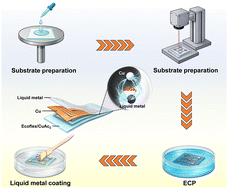
Liquid metals, particularly gallium-based alloys, have emerged as promising conductive materials for flexible electronics due to their high electrical conductivity and intrinsic fluidity. However, their poor adhesion and unstable patterning on soft elastomeric substrates remain critical challenges. Here, we propose a laser-activated metal deposition strategy to achieve robust interfacial bonding and high-fidelity patterning of eutectic gallium–indium–tin on Ecoflex substrates. This approach integrates laser-induced selective surface activation of Ecoflex/CuAc2 composites with electroless copper plating, creating spatially defined Cu patterns that serve as an interfacial regulating layer. The Cu interlayer chemically reacts with liquid metal to form intermetallic compounds, which establish strong interfacial anchoring and significantly suppress liquid metal dewetting and pattern distortion. The resulting Cu–liquid metal conductors exhibit stable and repeatable electrical responses under mechanical deformation and demonstrate reliable performance in monitoring human physiological motions. This work provides a generalizable interface-engineering strategy for realizing robustly adhered and geometrically precise liquid metal patterns on soft polymers, with potential for direct application in wearable strain sensors, epidermal electronics, and flexible interconnects.
 Please wait while we load your content...


