


 PLATFORM UPDATE:


Pressure effects on optical properties of zinc-based 0D hybrid halides
 *ad
*ad
Abstract
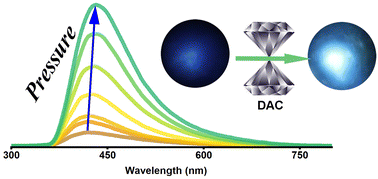
Zinc-based zero-dimensional (0D) halides with wide-bandgap materials exhibit great potential as a blue-light material system, yet their practical applications are impeded by the low quantum yield. Here, under high pressure, significantly enhanced deep blue emission luminogens are observed in the 0D hybrid halide ZnCl2-BZT, exhibiting over ten times greater intensity compared to the emission in their initial state at 4.5 GPa. Notably, the “sky blue light” emission is effectively retained under ambient conditions even after the pressure is completely released, which is over seven times more intense than the emission in the initial state, a remarkable quantum yield of 65.52% after decompression, exhibiting potential applications in advanced lighting and display technologies. Experiments and first-principles calculations reveal that the irreversible amorphous states, halogen-to-ligand charge transfer, and increased steric hindrance with respect to complexly configurational organic molecules [BTZ] are highly responsible for the eventual retention of “sky blue light” emission luminogens. The findings signify a notable advancement towards the retention of blue-light emission luminogens under normal environmental conditions, thereby enhancing their possible utilization in solid-state lighting applications.
- This article is part of the themed collection: New Developments in Photofunctional Materials and Transformations
 Please wait while we load your content...


