


Stability of organic field-effect transistors: from degradation mechanisms to synergistic stabilization

Abstract
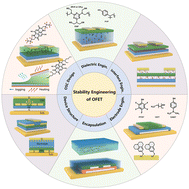
The rapid development of flexible and neuromorphic electronics is driving a fundamental transformation in device architectures. Organic field-effect transistors (OFETs) have emerged as a key component for such systems, offering advantages such as low-cost fabrication, excellent mechanical flexibility, and tunable semiconductor properties—with charge-carrier mobilities in some systems already surpassing those of amorphous silicon. However, long-term environmental stability remains a central challenge hindering their practical application. Exposure to moisture, oxygen, light, and mechanical stress often leads to performance degradation and shortened operational lifetime, severely impeding commercialization. While significant research efforts have aimed to improve stability, a systematic understanding of the physical origins underlying device failure is still lacking. This review systematically outlines the key factors governing OFET stability, categorizing them into two intrinsic and five extrinsic degradation mechanisms, and elucidates their physical nature and interrelationships. Recent progress in enhancing stability is summarized across several fronts: organic semiconductor design, dielectric layer optimization, electrode and interface engineering, device structure optimization, and encapsulation strategies. Given the complex coupling among different degradation pathways, optimizing a single parameter often yields limited improvement. Therefore, a holistic and co-design strategy that integrates materials, interfaces, and device architecture is essential to achieve robust and long-term stability. This review aims to establish a coherent theoretical framework and research roadmap to guide systematic stability improvements, thereby accelerating the industrial adoption of OFET technology and strengthening its potential as an enabling platform for next-generation flexible and neuromorphic electronics.
- This article is part of the themed collections: Journal of Materials Chemistry C Recent Review Articles and Journal of Materials Chemistry C HOT Papers
 Please wait while we load your content...


