


 PLATFORM UPDATE:


A thermally robust Dy3+-activated Sc2Mo3O12 phosphor for sustainable WLED lighting and phase transition-enabled visual cryogenic thermometry

Abstract
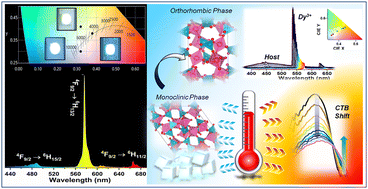
The development of phosphors exhibiting negative-thermal expansion (NTE) is urgent for achieving thermally robust luminescence performance of phosphor-converted white light-emitting diodes (pc-WLEDs). The current pc-WLEDs suffer from poor thermal stability, suboptimal color rendering index (CRI) due to blue-light exposure, and high correlated color temperature (CCT). Herein, we developed a promising Sc2Mo3O12:Dy3+ phosphor with bright yellow-white emission upon ultraviolet (UV) and near-UV light excitation. Local structure analysis using extended X-ray absorption fine structure (EXAFS) spectroscopy confirmed the occupancy of Dy3+ ions at octahedral Sc3+ sites. Temperature-dependent in situ X-ray diffraction study revealed a strong NTE effect in Sc2Mo3O12. Temperature-dependent photoluminescence studies demonstrated the excellent luminescence thermal stability of the Sc2Mo3O12:Dy3+ phosphor (91.4%@480 K) due to enhanced structural rigidity and reduced non-radiative decay as a result of thermally induced lattice compaction. The influence of the host's low-temperature phase transition on Dy3+ luminescence was examined under cryogenic temperature conditions. Furthermore, we demonstrated the fabrication of three prototype pc-WLEDs by coating the Sc2Mo3O12:Dy3+ phosphor onto a UV-LED chip with tunable WLED parameters, i.e., CIE, CCT, and luminous efficacy, which strengthens its suitability for commercial lighting. The optical thermal sensing based on charge transfer red-shift and phase transition-induced luminescence has been demonstrated with high relative sensitivity (Sr) values of 2.30 (70 K) and 1.14% K−1 (300 K) across different temperature regimes, from cryogenic to high-temperature conditions, respectively, with visual color tuning. This work highlights the potential of NTE-active hosts in designing pc-WLED phosphors with enhanced thermal stability to advance the commercialization of sustainable WLED lighting, and offers opportunities for flexible thermal sensing in complex environments.
 Please wait while we load your content...


