


Enhancing the proton conduction in α-zirconium phosphate nanoplates by amine intercalation
 *ab
Xueli
Liu
*a
*ab
Xueli
Liu
*a
Abstract
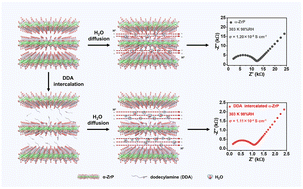
Amine intercalation is an efficient way to fine-tune and enhance the properties of layered α-zirconium phosphate (α-ZrP), however, its impact on the proton conduction properties of α-ZrP has been rarely explored. In this contribution, a long-chain alkylamine, dodecylamine (DDA), was successfully intercalated into α-ZrP nanoplates. The intercalation was seen to exert both positive and negative impacts on the proton-transport capabilities of α-ZrP. When the intercalant concentration was low, the hydrophobic long-chain alkyl groups of anchored DDA molecules hindered the diffusion of water, causing suppressed proton conduction. With a high DDA concentration, enhanced proton conduction was observed in the intercalated α-ZrP, due to the existence of expanded interlayer spacing and free DDA, which facilitated the diffusion and accommodation of water molecules, leading to an increase in carrier concentration and the formation of hydrogen-bonding networks. The optimized DDA-intercalated α-ZrP (α-ZrP-DDA (1 : 4)) showed a proton conductivity of 1.11 × 10⁻⁴ S cm−1 at 303 K and 98% relative humidity (RH), which was one order of magnitude higher than that of α-ZrP. Moreover, a humidity sensor based on α-ZrP-DDA (1 : 4) was fabricated, which could distinguish deep, normal and fast breathing, indicating its potential for practical monitoring of human breath. Our work demonstrates that amine intercalation is an efficient strategy for modulating proton-transport behavior in α-ZrP, thereby broadening its potential applications.
 Please wait while we load your content...


