


Charge-transfer doping in C3N2 vdWHs endows sub-5 nm FETs with near-Boltzmann switching and ultrahigh on-state current

Abstract
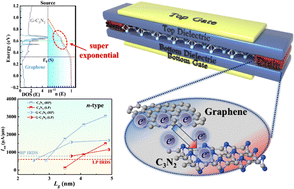
As microelectronic devices scale down, enhancing the performance of field-effect transistors (FETs) and reducing power consumption have become critical challenges. van der Waals heterostructures (vdWHs) offer a promising solution. This study systematically investigated the electronic structure of monolayer C3N2 and the quantum transport in C3N2-based FETs. We further constructed C3N2/graphene vdWHs to enhance device performance. Sub-5 nm C3N2 FETs exhibit excellent gate control, achieving high on-state currents (Ion), reaching 3035 µA µm−1 for high-performance (HP) applications and 1430 µA µm−1 for low-power (LP) applications, and an on/off ratio of 108. Their delay time (τ) and power-delay product (PDP) significantly exceed the International Roadmap for Devices and Systems benchmarks. For the constructed graphene–C3N2 vdWH FET, interfacial charge transfer is equivalent to high-concentration n-type doping; meanwhile, it weakens the Fermi level pinning effect and generates a certain “cold-source effect”. This synergistically enhances gate control, suppresses hot electron injection, reduces subthreshold swing (SS) by ∼10% (nearing the Boltzmann limit), and further lowers τ and PDP. Our work confirms the potential of C3N2 FETs for ultra-scaled electronics and proposes a vdWH strategy to synergistically optimize performance and power. This approach relaxes material constraints while improving gate control, offering new insights for designing post-Moore HP and LP transistors.
 Please wait while we load your content...


