


Structural phase transition and cooperative luminescence in K3Yb(PO4)2:Eu3+ for multimodal down-shifting and up-converting luminescence thermometry
 a
and
Lukasz
Marciniak
*a
a
and
Lukasz
Marciniak
*a
Abstract
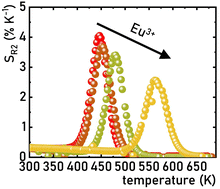
To develop a more universal luminescent thermometer that provides both high relative sensitivity and the ability to measure temperature across different spectral ranges and excitation wavelengths, the K3Yb(PO4)2:Eu3+ system was proposed in this work. It was demonstrated that this material undergoes a structural phase transition from the monoclinic to the hexagonal phase above 450 K. This transition enabled the construction of a ratiometric, phase-transition-based thermometer utilizing the luminescence intensity ratio of Stark lines of Eu3+ and Yb3+ ions, which exhibit SRmax values of 4.2% K−1 and 1.15% K−1, respectively. Moreover, increasing the Eu3+ ion concentration was shown to raise the phase transition temperature, thereby shifting the thermal operating range of both luminescent thermometers. Under 980 nm excitation, K3Yb(PO4)2:Eu3+ exhibits both cooperative luminescence from Yb3+ pairs and up-conversion emission from Eu3+ ions. Increasing the Eu3+ concentration enhances the Eu3+ luminescence intensity relative to the cooperative luminescence of Yb3+ pairs, resulting in a change in the emitted light color. The difference in the thermal quenching behavior of these two signals further enabled the development of a ratiometric thermometer with SRmax = 0.58% K−1. These findings identify K3Yb(PO4)3:Eu3+ as a promising candidate for multimodal temperature sensing applications.
 Please wait while we load your content...


