


 PLATFORM UPDATE:


Highly transparent and color-neutral Eu3+-doped glass luminescent solar concentrators for scalable BIPV integration
 a
Utku
Ekim,
a
Harun Samet
Çelik,
a
Miray
Çelikbilek Ersundu
*a
and
Ali Erçin
Ersundu
*a
a
Utku
Ekim,
a
Harun Samet
Çelik,
a
Miray
Çelikbilek Ersundu
*a
and
Ali Erçin
Ersundu
*a
Abstract
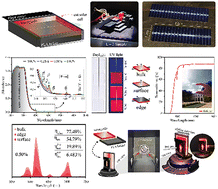
As urban design increasingly prioritizes energy efficiency and sustainability, building-integrated photovoltaics (BIPVs) have emerged as a compelling approach for on-site solar energy harvesting. Among these, luminescent solar concentrators (LSCs) offer transparent and architecturally compatible solutions by guiding spectrally shifted light to edge-mounted photovoltaic cells. In this study, we report the first demonstration of rare-earth doped (Eu3+) fully inorganic glass based LSCs, combining high optical performance, long-term environmental stability, and process scalability. By tuning the Eu3+ concentration, waveguiding losses are minimized, and the emission efficiency and photon transport are maximized. Devices fabricated with the optimal glass composition (2.5 mm thick; 2 to 6 × 6 cm2) exhibit outstanding average visible transmittance (AVT ≈ 90%) and near-neutral color rendering (CRI ≈ 98), enabling seamless integration into modern architectural environments. The glass matrix maintains its optical and structural integrity under thermal, chemical, and mechanical stress, confirming its long-term durability for real-world applications. External photon efficiency remains stable at ∼6.4% across all device sizes, while the highest power conversion efficiency (PCE) of 0.852% in the 4-edge configuration is achieved for the most compact device. These findings position Eu3+-doped glass as a robust, scalable, and multifunctional platform for the next generation of BIPV-integrated LSCs, offering a rare-earth-based solution for durable, visually neutral solar harvesting surfaces.
- This article is part of the themed collection: Celebrating International Women’s Day 2026: Women in Journal of Materials Chemistry C
 Please wait while we load your content...


