


6-Bit multilevel and highly linear synaptic plasticity in sputtered AlScN ferroelectric capacitors on (100) Si
 ab
Zhongming
Zeng,
ab
ab
Zhongming
Zeng,
ab
Abstract
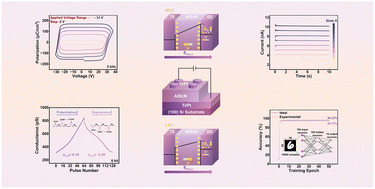
Aluminum scandium nitride (AlScN), with excellent ferroelectric properties and complementary metal-oxide-semiconductor (CMOS) compatibility, is a promising candidate for neuromorphic computing. Magnetron sputtering exhibits excellent compatibility with CMOS back-end-of-line (BEOL) integration and supports large-area, cost-effective film deposition, thereby establishing itself as the dominant fabrication route for AlScN thin films. However, sputtered AlScN synaptic devices often exhibit a limited number of conductance states and nonlinear weight updates, hindering large-scale deployment in neuromorphic systems. In this study, we report sputtered AlScN ferroelectric capacitors in which conductance modulation is achieved by controlling the polarization switching states of the ferroelectric layer. The devices provide at least 64 well-distributed conductance states and exhibit highly linear and symmetric weight updates, with nonlinear factors of αLTP = 0.18 and αLTD = −0.99. Simulations based on experimental data yield 94.72% recognition accuracy on the Modified National Institute of Standards and Technology (MNIST) handwritten digit dataset after 50 training epochs. In addition, the synaptic devices exhibit a fatigue endurance exceeding 107 cycles within the operating voltage range. After 107 switching cycles, the ferroelectric performance can be restored to 86.2% of the initial value through a recovery operation using higher-amplitude voltage pulses. These results confirm the feasibility of AlScN ferroelectric capacitors fabricated through fully CMOS-compatible processes to serve as high-performance synaptic devices and demonstrate the potential of AlScN-based ferroelectric devices for scalable and efficient neuromorphic computing applications.
 Please wait while we load your content...


